I was unable to source sheep milk for quite a while, so when I finally found a new source last spring, I promptly made a “young pecorino”, a semi-hard table cheese, which was great eating until it was about 6 months old, at which point it became an equally excellent grating cheese. I just finished the last stub of it last weekend.
I started a second one in early January for the sake of having more Eating Pecorino, having made another smaller sheep cheese in “cobblestone” form a week earlier. Winter milk has more fat than spring and summer milk across all species, but this turned out to be especially pronounced in sheep milk, which is a high-fat milk to begin with.
Here’s a picture I took of the two cheeses side by side, when the winter one was just out of the press and being salted (that’s kosher salt on the rind–you brush it off when you’re done salting). This winter one is ~30% taller. Same recipe, same farm for the milk, both made from 2 gallons of milk.

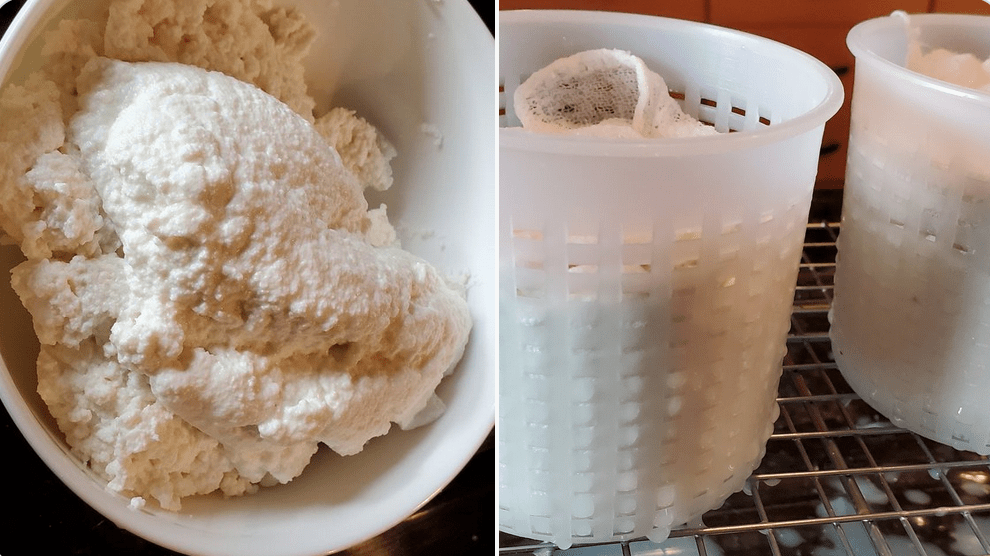
And I *also* got a full bowl of ricotta, enough to make 2 rounds of truffled ricotta salata. Incidentally, one of the best ways to taste the inherent differences between milks of different species is to make ricotta, because it basically has no other flavors besides “milk”. Cow ricotta is sweet but kinda bland. Goat has a noticeable lemon flavor. Sheep has a rich, buttery warmth to it that you should never hide in pasta fillings with heavy sauces. It’s lovely as a spread on bread (think Rondele, but less processed and gelatinous), as sliceable dry ricotta, and my favorite, mixed with some powdered sugar, lemon zest and tiny shavings of dark chocolate as a cannoli filling.
Here’s the winter pecorino at 2 months of age, at the beginning of March.

It was technically just about ready to eat, but the sheep cobble (pictured below) that I’d made the week before was so rich, creamy and soft-textured due to all the extra fat that I decided it wouldn’t hurt to let the Pecorino age longer and give the fats more time to break down.

But I wanted to point out something about the rind. Compare the two-month-old winter one above with the previous one I made in March of last year:
Both rinds were oiled during aging to help keep off unwanted molds. But the one I made in January is entirely covered in white geotrichum mold, while the spring one just has a dusting. I didn’t add any geo powder to the milk. That’s just what grew on the rinds, from spores in the milk and in the air.
The winter one has a lot more fat, which tends to retain more moisture in the curd. Here in the San Francisco Bay Area, winter is the dampest time of year. I often have to fight moisture-loving blue molds in the winter, and if you look closely on the winter pecorino you’ll see spots where the local blue started making pits in the rind before I ground lots of dry salt into it. So the winter one is a slightly moister cheese, aged in slightly damper conditions. More geotrichum is the result.
Even though I still have a bit of the super-rich sheep cobble, I opened up my wintertime pecorino yesterday evening.

Texture-wise, it’s pretty similar to the pecorino I made last spring. It doesn’t have the fatty mouthfeel the cobblestone has; it’s more of a proper semi-hard cheese (this is a good thing). There’s a definite flavor difference though. The spring one was nutty and a little sweet. This one has a bit more tang to it, with hints of hay.
I’m now planning to make another one in June with summer milk to get a 3-season comparison.
Originally tweeted by Lisa Caywood (@RealLisaC) on January 5, 2022.
 Into The Curdverse
Pingback: My First Cheese(TM): Ricotta | Into The Curdverse
Pingback: Ep5: Cheeses of the Season – Spring | Into The Curdverse