Honey-Rubbed Montasio

About six weeks ago, I started a Montasio, a mountain cheese from the Veneto-Friuli region of NE Italy.

I’d made it before, a very long time ago, and found it uninteresting, so I didn’t make it again. But! I came back to it last month because of a somewhat unusual finishing technique it sometimes receives: it’s coated with a few layers of honey in the early stages of aging. And I got this really interesting desert wildflower honey when I was in New Mexico that I thought would be great with the slightly nutty flavor of this cheese.

Let me explain about the honey.

Honey GIF

There are a number of long-aging cheeses where you oil the rind, creating an anaerobic barrier between the actual cheese surface and the surrounding air to help ward off molds.

Honey does the same, but it's got some even more interesting things going on:

Honey is pretty acidic. Actual pH varies quite a bit, but average in the upper 3s and low 4s. That makes for a pretty unfriendly surface for acid-sensitive microbes, yeasts and molds, of which there are many. You may have heard of honey being used on diabetics’ foot injuries; the combo of oozy spreadability (easy to get into small nooks and crannies)the acidity, and the anaerobic nature of the substance all make it a great way to seal off wounds from harmful microbes.

Now here’s the interesting thing about honey-rubbed Montasio: the first records of it come from a Benedictine monastery in the 13th c. That’s not to say that it didn’t exist before then, by any means. But it’s often aged for a really long time, and especially before the modern era, the people who had the real estate to age things for months or years, in the forms of caves & cellars, were the nobility and the Church. It’s why certain monastic orders are known for wine, cheese and beer: these were major sources of income for monasteries, which were often expected to be financially self-sufficient.

Honey, prior to the introduction of sugar cane & refined sugar from the Islamic world in the late middle ages, was pretty much the only source of sweetness in Europe. And it was a luxury item.

So guess what another major source of income for large manorial & monastic estates was? Honey.
So our Benedictine friends in NE Italy evidently had not only livestock, but also beehives. You can absolutely age Montasio without honey–oiling it, for example. But you might imagine that just like any modern enterprise, they may have had several different models in their product line, and the honey-rubbed version may have been the top of the line.

Some sources I've read also say Montasio was originally a sheep-milk cheese, or sometimes mixed-milk, but commercial versions I've seen, at least in the US, are all cow milk. So I'm making cow today. I may make it again with sheep milk some other time.

This is a fairly straightforward thermophilic cheese: heat the milk to 95F, add cultures, let them “ripen” or acidify the milk for 30 minutes, then add rennet and let it coagulate for another 30 minutes.

Also as it common with thermophilic cheeses, because you want to let a lot of the whey out, you cut the curd pretty small, .5cm. Then you cook them some more by slowly heating them to 110F over 30 mins, stirring slowly all the while.

After that, I turned off the heat and let the curds sit in the hot whey for another 30 mins, stirring every few mins, until the outsides were quite dry and not sticking to each other, and the individual curds were quite springy instead of squishy. Rubber band consistency.

Once the curds are cooked to the right consistency, you drain them and then press at about 20 lbs for an hour. Then lip the disc and press them for another 30 mins at 30-35 lbs, keeping them reasonably warm, 75-80 F, while they knit. The heat helps with the knitting process. The final weight of ~45 lbs stays on overnight.

Two other recipes for Montasio I have call for salting the curds before you put them into the press, which largely stops acidification. This one acidified for basically 18 hrs before I brined it the following morning.

Those other recipes also use 4-8x as much culture as this one. 🙂 So this is the very definition of low & slow fermentation. I’ve been liking the results of the low & slow approach better, which is why I opted for this one.

This is the baby Montasio just after being turned in its brine; it was there for a total of ~8 hrs. The final cheese is a bit salty, so I might do it for a shorter period of time next time.

After a couple of weeks of aging in the cave, the rind is fairly solid but not yet growing mold. That’s when the honey went on, 3 coats in all, drying for a day or so in between.

The honey is one I picked up on a trip to New Mexico. The Santa Fe Honey company is run by an extended family who has some 200 hives around the state. The majority are in the Rio Grande Valley, but some (like this one) are from the high desert and mountains. It’s got a dark caramel flavor with a hint of sage.

After a total of 6 weeks of aging, I can say that this Montasio is definitely better than the other ones I’ve made—mostly due to the milk, I think.

The last two I made were with standard supermarket milk and had that one-note sharpness of a lot of mass-market harder cheeses. This one is from raw Jersey/Brown Swiss milk, and has a richer, more buttery flavor. The honey on the rind isn’t really noticeable on its own, but if you eat slowly you get hints of the dark caramel along with the butter. It’s a fairly salty cheese, more than it is a sharp one.

Adding a dab of that same desert honey on a slice of the cheese makes all the flavors really bloom.

Ricotta2 Electric Boogaloo: Whey Ricotta

This one goes out to the yogurt and paneer makers, having been prompted by an exchange over on Twitter with a friend who had questions after reading the last blog on ricotta. It illustrates really well the core of all dairy product making: acid management.

Twitter friend: I’ve done quite a few batches of “ricotta” using the whey from Greek style yoghurt (and maybe adding am extra liter of whole milk). That whey makes almost bypasses the need for any extra acid to be added. What do you think?

It’s very possible to make ricotta from whey without adding more acid, because the whey is already somewhat acidic. Exactly how acidic will vary from one type of yogurt or cheese to the next, and also how long it’s been sitting around (the sugars in the whey continue to get converted to acid over time).

The acidity of the whey actually matters quite a bit–if the whey is still relatively “sweet”, say ~6.4 pH (fresh milk is ~6.6), you’ll still need to add acid. As it drops, less acid will be needed. There’s a good outline here.

On the other hand, if the whey is TOO acidic, the remaining solids won’t really coagulate. This is why you won’t get satisfactory whey ricotta after making an acid-coagulated cheese (eg paneer)–because the whey is already too acidic. At best, you’ll get a sort of dairy sludge if you strain the whey through cheesecloth. I’ve done this, and made a cheese spread with it, but it’s very dense, not light and fluffy like good ricotta.

You can counteract the high acidity of whey by adding more fresh milk to the pot to get the overall acid level back up above 6.0. Recipes specifically written for whey ricotta pretty much always include this step prior to adding acid, though the amount of milk you’ll be told to use again varies widely–often a couple of cups (1/2 a liter) to a gallon (4 liters) of whey, up to 50% of the current volume of whey. That’s because the acidity of the whey you happen to have could fall within a very wide range, and they’re trying to make it foolproof for you.

All of this assumes your whey is somewhere near 6.0 pH. The more acid (lower pH) it gets, the more likely you’ll be adding whey to a pot of fresh milk rather than the other way around.

If you don’t happen to have a foodsafe pH meter (I don’t), you can gauge acid levels very roughly by taste (below is courtesy of cheesemaking.com):

  • pH 6.2-6.5 the curds and whey should taste sweet like milk
  • 5.8-5.7 the curds will still have a slight sweetness but nearing neutral*
  • 5.5-5.4 they will taste neutral, neither sweet nor acid.
  • 5.2-5.3 a slight acid tang develops
  • 5.1-4.9 a definite acid tang
  • 4.7-4.4 and below the taste begins to have the tang of a euro style yogurt

*Note that different milk types such as goat and sheep taste different, and typically not quite as sweet as cow, when they’re fresh. So you need to know what the fresh milk of the kind you’re using tasted like in order to use this as a guide.

You can also buy foodsafe pH strips from a variety of online sources including Amazon, and those are pretty easy to use. The most useful ones test for a relatively narrow pH band (say 7.0-4.0), mainly because the color guide they give you to compare the test strip against will show finer .x gradations.

None of this examination of pH levels is in any way REQUIRED to make whey ricotta, so definitely don’t let the preceding few paragraphs scare you off. Just find a whey ricotta recipe, add some milk unless the whey is already really cloudy, however much acid they tell you, and off you go.

But if you’ve attempted whey ricotta and you’re not getting satisfactory results, now you can make better guesses as to why.

Tangent alert!

Traditional Greek yogurt is made from sheep milk, not cow milk, and often isn’t strained at all.

How does it get so thick? Sheep milk has a lot more solids in it than cow milk does: more than twice the amount of fat (7+ % vs 3.25-3.5%), and nearly twice as much protein. With all those solids, it really doesn’t take much at all to get them to find each other and link up in a coagulated mass. You’ll find if you work with sheep milk that you’ll get nearly twice as much curd as you would with the same amount of cow milk.

And if you eat a whole pot of sheep yogurt for breakfast, you’re unlikely to need lunch. I speak from personal experience here.

My First Cheese(TM): Ricotta

Play kitchen (via Wikimedia)

One of the most common questions I get when I mention I make cheese is “Wow, I’d love to make cheese! What should I start with?” to which the best answer is pretty much “ricotta”, or if you have a Central European grandparent, “pot cheese”.

Here’s why:

  • Ricotta is nearly foolproof and doesn’t require any special equipment.
  • Homemade ricotta is obviously different from and better than commercial ricotta–no weird, pithy texture, no stabilizers, just soft, pillowy goodness. Quick, easy wins are good when you’re a complete n00b–they give you the boost of confidence and interest to keep going.
  • Making a batch of cow ricotta and another from goat milk (and sheep, if you can get it) is a great way to get a sense for the differences between different milk types. There are flavor differences, as I mentioned in my post on Pecorino, but they also coagulate differently and you’ll get different amounts of ricotta from the same amount of milk. The size and texture of the curds will be different. These are all useful things to get a feel for before you start playing around with other, more complicated types of cheese.

You’ll find the ricotta recipe near the beginning of pretty much every cheese cookbook, and there are hundreds of recipes for making it all over the Internet. And therein lies the rub: the myriad different recipes vary wildly, which can be pretty overwhelming and confusing for someone who’s just trying to figure out where to start.

The good news is, they’ll all work, just with slightly different results.

Let’s start with the basic ingredients:

Milk. The level of milkfat in the pot affects yield. You can use either 2% or whole milk, both will work. You’ll just get a lower yield with 2% and of course it will have a less creamy mouthfeel.

The milk can be raw or pasteurized. It absolutely doesn’t matter. You’ll be blowing past pasteurization temperatures on your way to making ricotta in any case, so don’t go out of your way to pay extra for raw milk. Pasteurization is a function of both temperature and time, and the relationship is not linear. Here’s the time-temp scale for pasteurizing milk:

  • Low-temp or vat pasteurization: 145F (63C) for 30 minutes
  • High temp, short time (HTST): 161F (72C) for 15 seconds
  • Higher heat, shorter time (HHST): 191F (88C) 1 second

When you make ricotta, you’ll be heating the milk to ~195F and holding it there for 10-20 minutes. So if you come across that recipe from that guy who tells you to get raw milk and then pasteurize it for 30 minutes before you continue with the recipe, ignore him and absolutely anything he says on the subject of milk or cheese forever.

Cream? Many recipes will tell you to add cream to the milk. The proportion of cream to milk ranges from 1/4 cup to 1 gallon, to (in one remarkable recipe) 2 cups of cream to 4 cups of milk. At that point you’re halfway to cream cheese, but hey, go for it if that’s what you want. You don’t actually need to add cream at all if you don’t want or don’t happen to have any on hand. Remember that ricotta is often made from whey left over from making a batch of cultured rennet cheese, from which most of the solids, both fats and proteins, have been removed. And you can make ricotta with 2% milk. Cream is just about yield and mouthfeel.

Note I’ve been noticing a number of brands have started adding carrageenan or other gums to cream to make it appear thicker when poured. I’ve even encountered it in one brand of goat milk. So, weird as it may seem, make sure to look at the ingredients list for your milk and cream. It should be just milk or cream, nothing else.

Incidentally, cow milk is the only kind from which the cream separates out easily. So your options when making goat ricotta are either (a) don’t worry about adding any cream–goat milk is higher in fat than cow milk anyway, or (b) add cow cream. Especially if you’re making goat ricotta for the purpose of seeing how it’s different from cow ricotta, I advise A. Sheep milk? It’s got twice as much fat as cow milk. Don’t even think about adding cream.

Acid There are range of options here: citric acid, lemon juice and white vinegar are the most common. I linked to a recipe using white vinegar in the post about Pecorino simply because it’s something that most people have ready access to, and the acidity levels are pretty uniform across brands. You can also use buttermilk.

By now it should be pretty clear that there’s a huge amount of room for experimentation.

Things most recipes don’t tell you, but which are actually fairly important:

Stirring technique Stir up and down, in a ferris wheel motion, not in a horizontal circle. Milk scorches easily, and you want to keep the temperature even from the top to the bottom of the pot. The larger the volume of milk you’re working with, the more important this is. A flat skimmer is an ideal implement, but any large, fairly flat spoon will work, or even a potato masher.

You can make two batches. If you’re starting from milk and not whey, the first application of acid will loosen the bonds that keep the solids in solution, but once you skim out the curds, you’ll still have a fairly cloudy whey in the pot. Add a second batch of acid and wait another 10-20 mins. You’ll typically get a larger yield from the second batch than the first, though it will be slightly lower in fat. (Some people add an extra cup of milk or 1/4-1/2 c of cream to the pot before adding the second batch of acid for this reason.) Just mix it in with the first batch after it’s drained.

Draining Cheesecloth isn’t always easy to find in your average supermarket. Sometimes you’ll find it in the section with cooking utensils. But you can easily order some from Amazon (Grade 90 or 100 is fine). You can also use a clean linen towel (flat weave, not the bumpy ones) or cut a square from an old all-cotton sheet or pillow case a bit larger than your colander. Boil it before you use it to sanitize it, and make sure it’s wet before you put the curds in it so they don’t stick to it. After you’re done, rinse any clinging curds from the cloth with COLD water (hot water will make them stick harder). And then you can just throw it in the wash with other clothes and some chlorine bleach for next time.

Then give Ep 2 (the overview of cheesemaking) another listen, and see how it hits after you’ve done it once.

Milk Is Seasonal: A Tale of Two Pecorinos

I was unable to source sheep milk for quite a while, so when I finally found a new source last spring, I promptly made a “young pecorino”, a semi-hard table cheese, which was great eating until it was about 6 months old, at which point it became an equally excellent grating cheese. I just finished the last stub of it last weekend.

I started a second one in early January for the sake of having more Eating Pecorino, having made another smaller sheep cheese in “cobblestone” form a week earlier. Winter milk has more fat than spring and summer milk across all species, but this turned out to be especially pronounced in sheep milk, which is a high-fat milk to begin with.

Here’s a picture I took of the two cheeses side by side, when the winter one was just out of the press and being salted (that’s kosher salt on the rind–you brush it off when you’re done salting). This winter one is ~30% taller. Same recipe, same farm for the milk, both made from 2 gallons of milk.

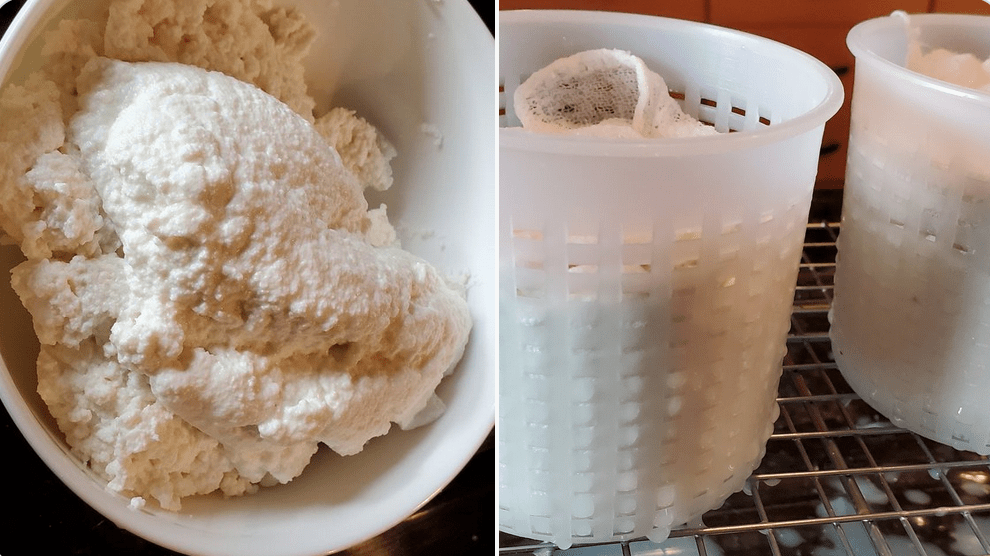
And I *also* got a full bowl of ricotta, enough to make 2 rounds of truffled ricotta salata. Incidentally, one of the best ways to taste the inherent differences between milks of different species is to make ricotta, because it basically has no other flavors besides “milk”. Cow ricotta is sweet but kinda bland. Goat has a noticeable lemon flavor. Sheep has a rich, buttery warmth to it that you should never hide in pasta fillings with heavy sauces. It’s lovely as a spread on bread (think Rondele, but less processed and gelatinous), as sliceable dry ricotta, and my favorite, mixed with some powdered sugar, lemon zest and tiny shavings of dark chocolate as a cannoli filling.

Here’s the winter pecorino at 2 months of age, at the beginning of March.

It was technically just about ready to eat, but the sheep cobble (pictured below) that I’d made the week before was so rich, creamy and soft-textured due to all the extra fat that I decided it wouldn’t hurt to let the Pecorino age longer and give the fats more time to break down.

But I wanted to point out something about the rind. Compare the two-month-old winter one above with the previous one I made in March of last year:

Both rinds were oiled during aging to help keep off unwanted molds. But the one I made in January is entirely covered in white geotrichum mold, while the spring one just has a dusting. I didn’t add any geo powder to the milk. That’s just what grew on the rinds, from spores in the milk and in the air.

The winter one has a lot more fat, which tends to retain more moisture in the curd. Here in the San Francisco Bay Area, winter is the dampest time of year. I often have to fight moisture-loving blue molds in the winter, and if you look closely on the winter pecorino you’ll see spots where the local blue started making pits in the rind before I ground lots of dry salt into it. So the winter one is a slightly moister cheese, aged in slightly damper conditions. More geotrichum is the result.

Even though I still have a bit of the super-rich sheep cobble, I opened up my wintertime pecorino yesterday evening.

Texture-wise, it’s pretty similar to the pecorino I made last spring. It doesn’t have the fatty mouthfeel the cobblestone has; it’s more of a proper semi-hard cheese (this is a good thing). There’s a definite flavor difference though. The spring one was nutty and a little sweet. This one has a bit more tang to it, with hints of hay.

I’m now planning to make another one in June with summer milk to get a 3-season comparison.

Originally tweeted by Lisa Caywood (@RealLisaC) on January 5, 2022.

Caciocavallo: How It’s Made

I had Ep 3 all set up for publication when this video popped in my feed. Since Caciocavallo is one of the cheeses I mentioned in the pasta filata section, here’s an annotated thread on what’s going on in this video:

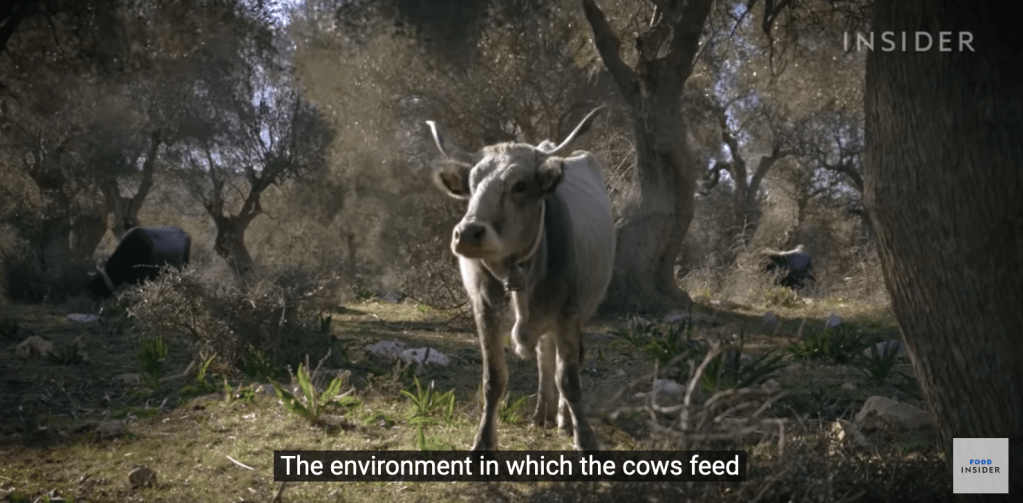
At :19 they talk about the breed used for this particular version of Caciocavallo, the Podolica cow. At 1:37 they mention that the breed gives only 3-6 liters (.75-1.5 gal) per day. By comparison, black & white Holsteins, the source of most North American milk, give 30-40 liters/day.

You might wonder why they would bother with a breed that gives so little milk when they could just get Holsteins–more milk for the buck, so to speak. Some of it is heritage, a belief in preserving local breeds and foodways. Some of it is flavor: different breeds give different proportions of fat and proteins. Holstein milk tends to be “watery” compared to breeds traditionally used for cheesemaking, so it’s not that great for cheesemaking. In addition, different breeds require diff amounts of water, or get along more or less well on different feed types, which make them sometimes better suited to the local environment than breeds from other ecozones. Holsteins & Holstein hybrids have fared quite poorly in India, for example–they get sick a lot.

At 1:45 they talk about the environment in which the cows are raised: near sea level, close to the coast, with brackish lakes nearby, and presumably salt-tolerant plants to graze on. We are what we eat, and so are animals–and their milk.

The milk is heated to 40C/104F. Most pasta filata–and many other Italian cheeses–are brought to fairly high temps like this, but Caciocavallo is aged longer than Mozzarella, so it’s heated to a higher temperature. The higher heat helps the acid develop more quickly, but there are other reasons to use the higher heat: thermophilic cultures (the one that like higher heat) tend to be more active in the finished curd for longer, so they help maintain consistent rate of fat and protein breakdown over time. And during the make, the higher heat causes the proteins in the curd to tighten more and expel more of the whey. So the curd is drier to begin with, which also allows it to age longer.

At 2:10, the cheesemaker adds rennet & whey from the previous day together to the milk. The whey contains cultures & acid, so it’s what kicks off the fermentation process. This is the traditional way (heh) cheese was made, before the development of freeze-dried cultures.

It also makes for more variability in the cheese esp between seasons: when it’s cooler, the whey won’t be as acidic, certain cultures may be less active, etc.

With many cheeses, you add the culture solution first, wait for a while, then add the rennet. The rennet slows down the fermentation. But in the approach shown in this video, the curd is going to spend a long time developing the right acid levels AFTER the curd is cut so it makes more sense to coagulate the milk relatively quickly, and then cut it.

At 2:15 we’re introduced to the cutting instrument, the menaturo:

It’s quite unlike the metal cheese harps used elsewhere, which cut the curd into nice even blocks. Here, the goal is to cut the curd into very small pieces, so he basically beats it apart.

Notice that it’s made out of wood. And so’s the vat that they move the curd to for ripening. Wood is a wonderfully porous material that absorbs all kinds of local yeasts and cultures to help reinforce what’s already been introduced with the whey.

While the curd sits in the warm whey, it continues to acidify, which is really important in pasta filata cheeses. Fresh milk has a pH of ~6.6. When the curd goes into the warm vat of whey, it’s usually ~6.0. It reaches stretchability between 5.3-5.1. Here’s a nice blog on the subject of acid and stretchiness in cheese if you want to dive further into that.

Once the curd has reached the right pH level, it’s cut into strips to get it ready for stretching. NB. Because it’s stretched at such a high temp (100C/212F!), the curd is pasteurized during the stretching process.

But the USDA doesn’t see it that way: because most caciocavallo in the US is served young, they insist the milk has to be pasteurized prior to cheese manufacture. This does impact the strength of the proteins and ultimately the stretch of the cheese….

Back at 4:22 they talked about the yellowish color of the curd, and the fact that it comes from the milk and what the cows eat. I talked about yellowness a bit in this post: tl;dr some cow breeds retain more of the beta-carotene from grass than others. The hue is also retained in the milkfat, so more fat, more yellow.

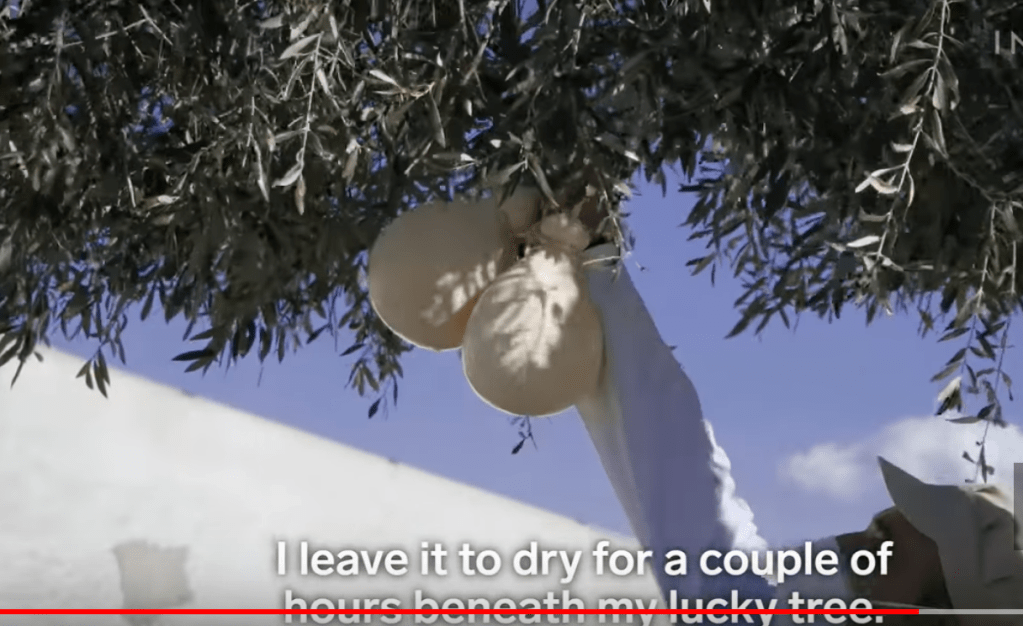
Finally, at 8:02, the cheesemaker talks about hanging the cheeses from his “lucky tree”.

It’s not just magical thinking: the surfaces of the cheese get turned without human help and dry quickly thanks to the slightly salty sea breeze. And also the cheese gets an extra dose of local yeasts and other microfauna for that extra terroir before it settles into the cave for aging.

Originally tweeted by IntoTheCurdverse (@curdverse) on April 3, 2022.

The Backstory on Making Gorgonzola

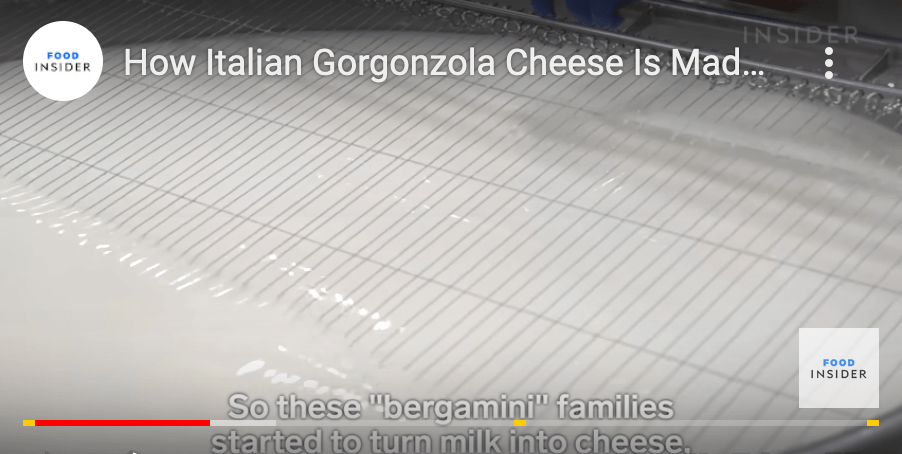
This video on how Gorgonzola is made makes the rounds pretty regularly. When I was first learning to make cheese, I found a lot of these videos interesting but kind of confusing–there’s a lot that goes unexplained. So here’s a thread of annotations!

Here the narrator talks abt where the cheese “can be made”. It’s not that it literally, physically, can’t be made elsewhere, but the name “Gorgonzola” is protected under EU and Italian law, rather like “champagne”…

The EU Protected Designation of Origin (PDO, or DOP in Italian) and the national level DOC are extremely valuable certifications. In many cases the rules specify not only where the product can come from, but also the species of plant or animal that must be used in its production and sometimes, how it’s made.

The species & breed designations have been extremely important in protecting the economic viability of heritage breeds: because the PDO designation allows producers to market and charge for premium products, they can afford to use traditional breeds that may not be as high yielding as the workhorse breeds used by mass-market producers, but have unique characteristics that make them better suited to being raised sustainably in their traditional regions: they require less water for example, or they tolerate cold or heat especially well and can spend most of their time outdoors, or they’ve developed a resistance to local diseases and pests. Tl;dr the PDO scheme and earlier national ones play a significant role in preserving biodiversity in both plants, like wine grapes, as well as livestock.

The specifications about how a product can be made primarily protect the producer economically–it means that they don’t have to find endless ways to speed up their processes in order to stay profitable. But that economic support for slower production turns out to be meaningful on a microbiology level for fermented products like cheese. By allowing the microbes to do a slow, thorough job of working through the curd, we consumers get a greater range of flavors–which are the byproducts of the metabolization of fats & proteins–and also fewer of the proteins that can be inflammatory for some people are intact enough to cause problems. And for everyone, our own guts have to do less of that same breaking down & metabolizing work.

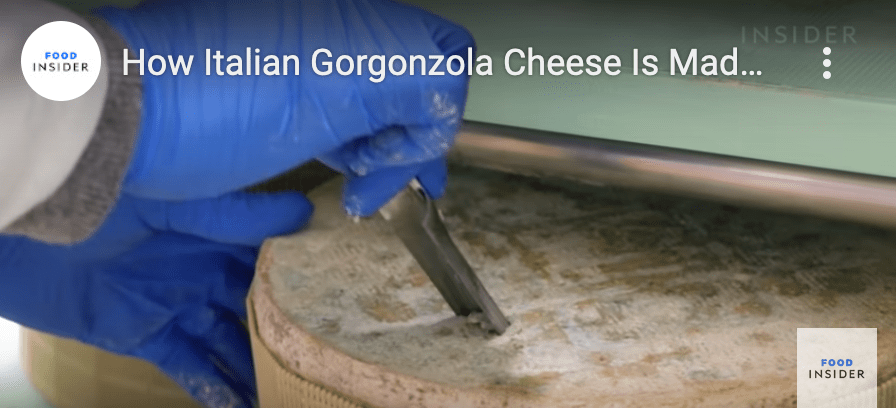
At 1:09 we see a tool is called a trier. You’ll see it a bunch of times throughout the video. It allows the producer to check on the state of the interior of the cheese without disturbing the whole rind or exposing too much of the interior to new things.

After they look at the sample, they carefully fit it back into the tunnel they made, and then seal the cut mark on the rind (traditionally with a smear of the cheese) to prevent oxygen and ambient yeasts from further entering the interior.

This tool at 1:57 is called a cheese harp. Once the milk has coagulated into a gel, it’s used to cut the curd into squares in order to release the whey.

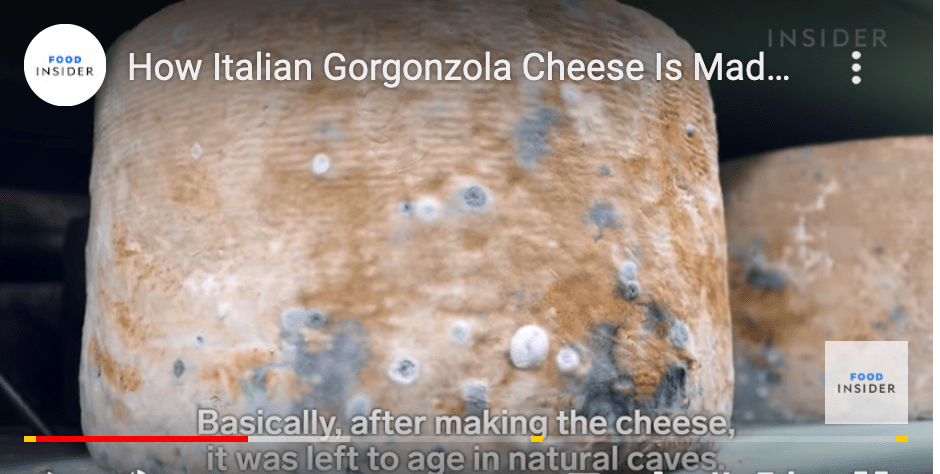
Americans are often weirded out by mold, but it’s absolutely part of the cheesemaking process, and its presence on the rind as the cheese ages is a big part of what flavors the cheese.

Producers will often brush off the ones that grow too tall, sometimes spot-treat any that they don’t want there. Big producers of long-aged pressed cheeses that normally have “natural rinds”–especially those selling to the American market–often slap a breathable film on their cheeses as it makes it easier to brush off “unsightly” molds and maintain even, pristine-looking rinds. But this is the opposite of how cheeses are normally aged, and it comes at the expense of complex flavor.

Here at 2:28 you can see a sort of plastic girdle around the center of the cheese. This isn’t something that’s used on every type of cheese. It’s just that these cheeses are both tall and very soft, and the girdle helps it stand up straight and maintain its shape during the aging process.

The same sort of thing is used on Vacherin Mont d’Or, a very soft, gooey cheese from the French Alps. I used spruce versions for aging my Spruce Button cheeses.

At 2:51 they talk about the 2 different kinds of gorgonzola, the softer “dolce” and firmer “picante”. They start out the same, but one is aged longer. They don’t say in the video which is older, but it’s the picante version.

This is true for most cheeses: they dry out as they age and that intensifies the flavors. The exception are surface-ripened cheeses like bries and other bloomy rinds, where yeasts & molds work their way into the interior of the cheese, eating through the protein structures as they go.

At 3:32 they talk about penicillium roqueforti, the blue mold, being added to the milk along with the other starter cultures. P. roqueforti is the most common strain used in blue cheeses, but its cousin P. glaucum is used in some blues instead such as Bleu d’Auvergne and, in fact, some gorgonzolas. Glaucum is more of a grey-blue and has a slightly milder flavor than roqueforti.

But these are just 2 of many, many blue strains that exist in the wild, and there are numerous substrains within each of those. These are the ones that people decided they liked and isolated so as to ensure consistency in cheesemaking. The blue mold that grows on the bread you keep in a plastic bag may be one of these, or it may be a slightly different one. If I let my aging cave get too moist, I risk having it get colonized by my local blue mold–which is a purple-blue, and has an acrid peppermint flavor which can permeate a cheese even if it only gets on the rind.

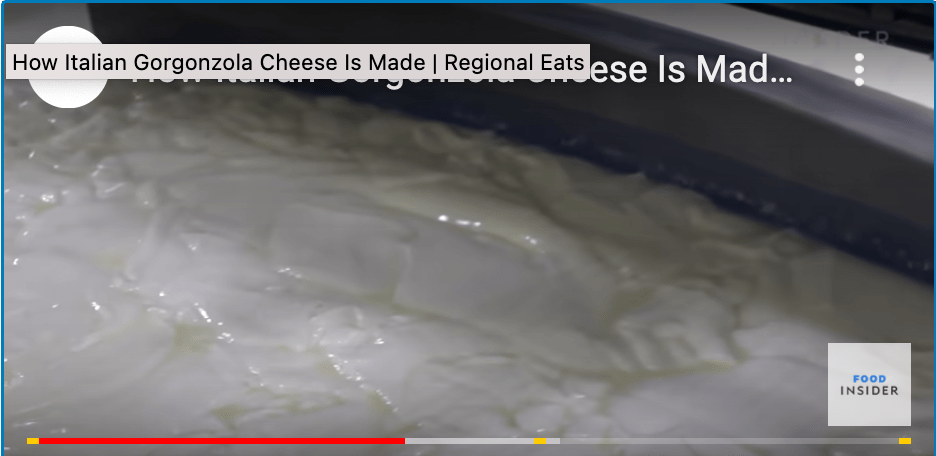
The section from 3:37-3:42 is kind of confusing, because they just jump from adding starter cultures & rennet to liquid milk, and then cutting the coagulated curd, and it’s not obvious that time has passed. But at a later point they say it’s abt 20 mins.

At 3:45 we see the curd harp again. The worker does one cut, then walks 90 degrees around the pot to cut again, forming a checkboard of cuts so that there are evenly cut squares of curd throughout the vat.

20 mins is not long at all, and as you can see at 3:52, the curd is extremely soft and delicate. If you watch other videos about harder cheeses, you’ll see the curds are often smaller, but also much firmer and easier to pick up.

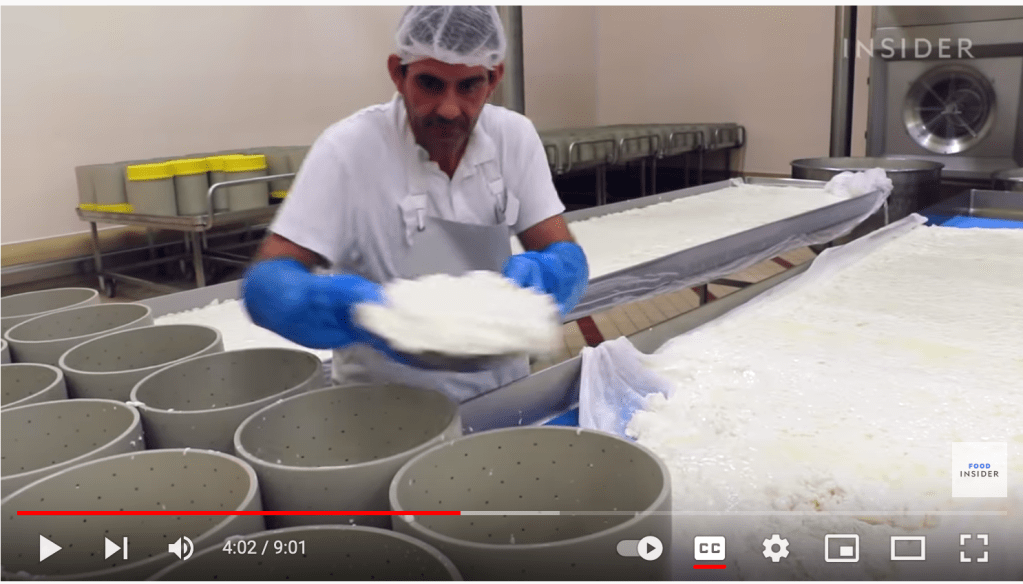
At 4:02 you see the workers scooping the curds up w/bowls and pouring them, whey and all, into the molds. Because these curds are so soft, they naturally slip together and close up open space left as the whey drains out the bottom.

At 4:30, the cheeses are left to drain overnight. People often assume these means they’re refrigerated, but that won’t happen for several days. The starter cultures need fairly warm temps–75-90F usually–in order to work on consuming the lactose in the milk and convert it to acid.

Acid means flavor. If you’ve ever had a really bland cheese, that’s a cheese where acid production is stopped at an early stage in the cheese making process. The salting shown at 4:34 is the point where that acidification is stopped the next day.

Stopped on the rind, in any case. There’s still stuff going on inside the cheese. There’s still lots of whey in the curd at this point, and the cheeses will continue to shed whey for several more days. The salt on the rind helps draw it out.

Whey flows faster at higher temps, which is why the cheeses then spend a few days in a “warm” room (usually in the 60s F). The picante versions spend more time there both to draw out more whey, and to give the mold spores more oppty to grow aggressively.

Puncturing: not all blue cheeses are punctured, but most are–and it’s pretty unique to blue cheeses. The holes in the rind are there to allow the blue mold spores access to oxygen as they’re starting to sprout.

These are still very young cheeses, though. The curd and rind are soft and still actively trying to knit together. So just like a cut on your skin, the holes will close up pretty quickly as the cheese ages. But by that time the mold spores will have gotten going. Because the cheese wasn’t pressed and the curds just kind of found their own places as they were placed in the molds, there are actually a lot of little open seams within the cheese, which allows the mold spores to effectively send out runners and spread thru the cheese. By the way, Cheesescience.org is a great resource for all the microbial details of cheesemaking for the Average Joe. He has a good article on the doings of P. roqueforti inside a cheese.

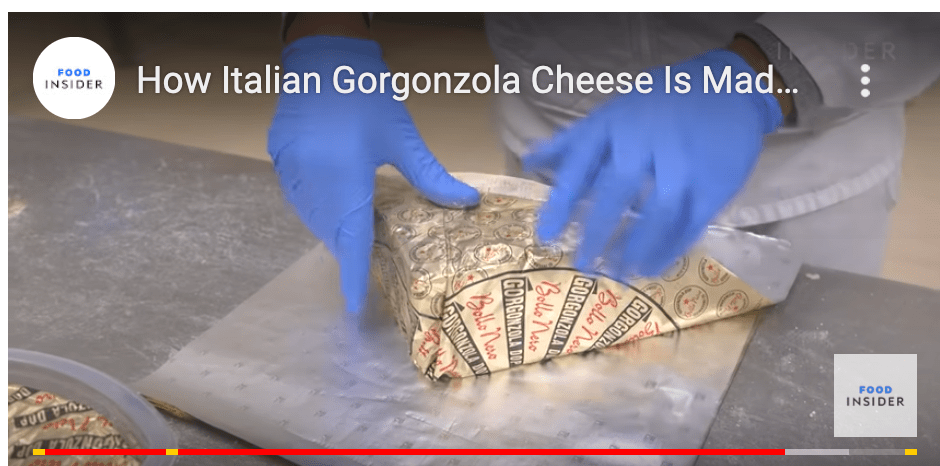
Finally, at 7:34, they talk about the foil wrapping. But in the video they mostly talk about it in terms of displaying the DOP designation I talked about earlier.

But there’s a reason it’s foil, and not some other type of wrapping: blue molds are REALLY aggressive. They will happily colonize anything given the chance. Many cheeses are wrapped in special papers or plastic films (think of that white paper around your Camembert) that allow the cheese to breathe as it’s transported from the manufacturer to a store.

But no retailer wants the blues colonizing the rest of their cheese case, and you don’t want them doing that to everything else in your fridge. So, just as tinfoil hats are good for keeping your thoughts from getting out to Them (whomever you’re afraid of), foil is used to keep your blues contained. /fin

Think About It Reaction GIF by Big Potato Games

Originally tweeted by IntoTheCurdverse (@curdverse) on March 19, 2022.

Why Some Cheeses Are Orange

Cheese isn’t naturally orange. These days the orange color comes from the seeds of annatto, a Central/South American plant. But the desire for yellow-hued cheeses goes back at least to the middle ages, and possibly even earlier…

The yellow and orange-colored cheeses are especially common in Northern Europe, where the majority of cheeses are made from cow milk. Cow milk has less fat than either sheep or goat milk, so it tends to have a more translucent quality to begin with.

In the later middle ages, especially in England & Holland with their rapidly growing urban middle classes, demand for butter–long a great luxury–was soaring. Which left dairyfolk w/a bit of a dilemma. They made a lot of money on butter, so there was real incentive to skim the cream off their milk before turning it into cheese. Certain breeds of cattle retain a fair amount of beta-carotene in their milk, but it mostly stays with the fat. Lower fat cheese, more of a dull-white hue. So for sales purposes, there was now also incentive to add colorant to the cheese. The video that spurred this post mentions marigold, in the days before South American plants were readily available in Europe.

But there’s another option: Lady’s Bedstraw

As that blog describes, Lady’s Bedstraw has long been used for dyes and also medicinal purposes. But it has yet another property: it’s a coagulant.

We don’t actually know when people started using animal rennet, but for most of history, plant rennets would have been more accessible for most people. I describe this a bit more in Ep 2. In the Mediterranean basin, fig sap, thistles and nettles were commonly used. But those aren’t things that grow as widely in northern Europe. OTOH Lady’s Bedstraw grows all over the place.

So it’s possible that Northerners were used to cheese being slightly yellow for centuries, long before the issue of fat levels came into question.

Originally tweeted by IntoTheCurdverse (@curdverse) on March 15, 2022.