In January of 2024, a rash of headlines breathlessly reported a cheesemaking “crisis” based on the news that manufacturers of the mold powders used in commercial cheesemaking are starting to have difficulty getting the molds to produce new spores. This issue is especially acute with white molds, but blue molds are starting to see some challenges as well. In this interview with Josh Windsor, we dig into the science behind the headlines–and what it really means for cheeses of the future.
When I first arrived in France in my youth and was presented with a wedge of brie after dinner, I did what most Americans do: I cut off the tip. And was promptly admonished. You’re supposed to cut along the side, getting a very thin wedge for yourself so that everyone else partaking of the cheese can do same, everyone getting an equal amount of rind & paste. At the time, it was explained to me as politesse.
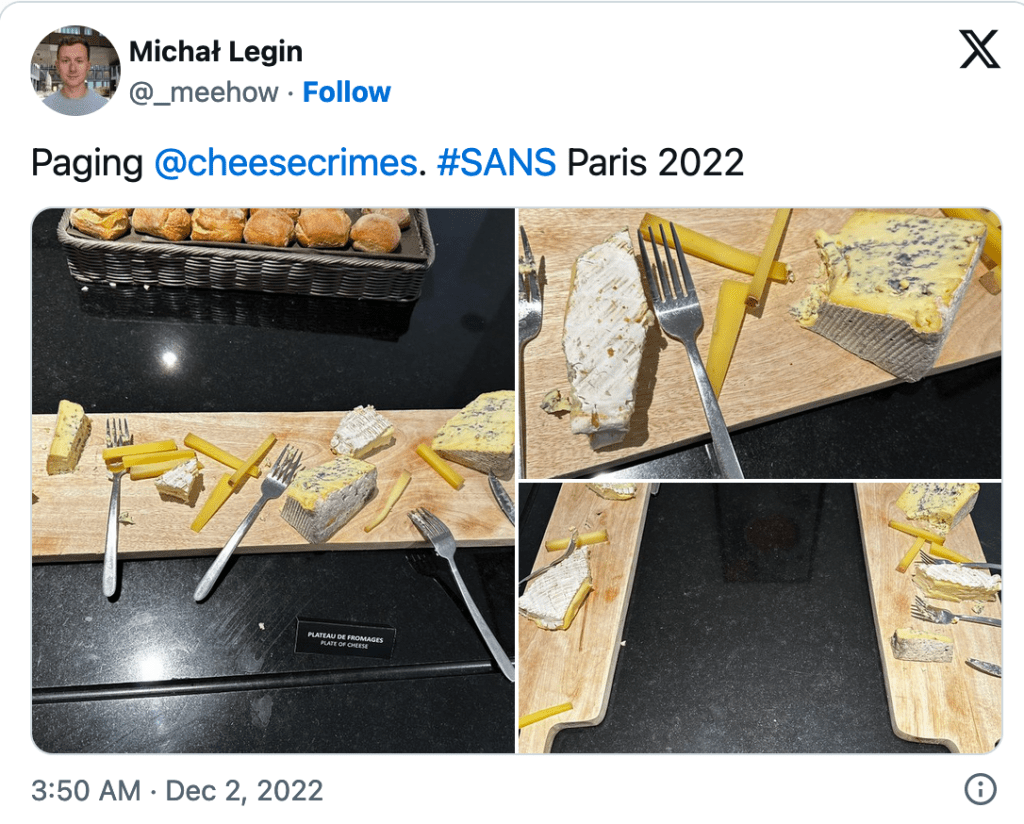
I was reminded of that moment when this popped up in my Twitter feed the other day:
There it was, my long-ago crime, compounded many times over by many different people and splashed across the internet. (I did, in fact, confess to my own commission of this crime on Twitter a couple of years ago.)
Let’s dissect this particular crime scene for a moment: the board contains 3 types of cheese, a white bloomy rind, a semi-firm cheese (the one cut into sticks that look like French fries if you’re not looking closely), and a blue cheese. This is a common number and the usual assortment of cheese types.
Two of these cheeses, the bloomy and the blue, are mold-ripened cheeses. The bloomy ripens from the outside in (cf Ep 7); the blue, at least as far as the blueing is concerned, from the inside out (Ep 8). So if you cut off the tip, you’ll get either the most (for the blue) or the least (for the bloomy) ripe part of the cheese, while everyone after you gets progressively riper or less blue portions and more rind . And the rind itself contributes flavor & texture, so ideally you want to experience it in a consistent ratio to the interior. Thus the desire to have everyone cut themselves a small slice from the side, allowing equal portions of interior (the paste) and the rind for everyone.
In general, you won’t go wrong doing that with any kind of cheese. But then why is the other cheese pre-cut in matchsticks? This was a catered event, not a private gathering, and you don’t want everyone who comes along wrestling to cut from a large, hard wheel of cheese. It breaks the flow of the food line. So you might as well pre-cut a hard cheese that won’t stick to the board at room temperature (unlike a well-made bloomy), especially since food waste is calculated into the catering budget. The cut pieces will dry out slightly, having been cut in advance, but harder cheeses are basically pretty stable at room temperature for long periods of time. This particular cheese is in matchsticks because the source wheel is fairly large and tall. So the prep staff cut out thin wedges, and cut each wedge across (just a little bit of rind on each end for everyone), and discarded the very thin end and the thick outer edge in the back.
Once you understand the basic principle here — complete, balanced taste and texture for yourself with each piece of cheese, and the same for everyone else — any other seemingly arbitrary rules about cutting cheese should start to make sense.
That said, there’s an excellent video by the late Anne Saxelby that delves a bit further into the different cheese types, and does a great job of explaining the nuances and reasons for cutting a cheese one way vs another. It’s also a very soothing way to while away a bit of a lazy weekend afternoon or evening. If you’re short on time, though, skip down below the video for a few words about knives.
Just as it’s possible to lay out 8 different kinds of forks, 3 knives, and a multiplicity of spoons at a fancy meal, each with its own specified function, it is possible to put out multiple kinds of cheese knives. The reality is, if you’re putting out a board for your guests to serve themselves…well, unless everyone you know is a great cheese enthusiast, virtually no one will know one from the next and everyone will use whichever knife comes to hand to cut whichever cheeses they want.
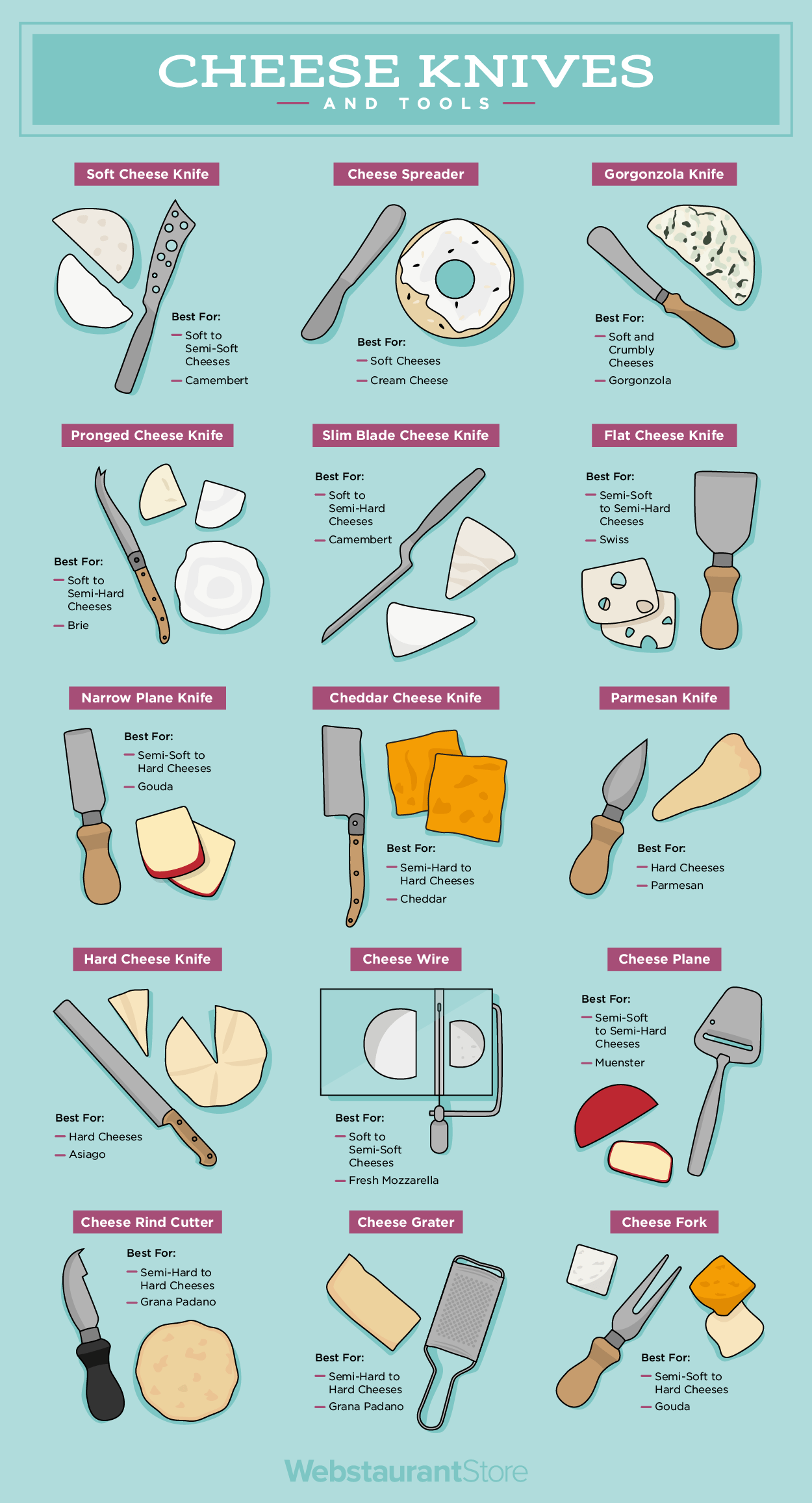
My pragmatic recommendation is to keep a paring knife at the soft-cheese end of your board, and a larger, sturdier knife at the hard cheese end. It cuts down on the number of times you get brie (and the mold spores it contains) smeared across your pecorino. You might also choose to keep a blue on a separate board with its own knife, as blue molds are even more aggressive. Of the knives in the graphic below, the one that I’ve found that is genuinely better for its purported function than the general-purpose knives one normally has in the kitchen is the Soft Cheese Knife. Because there’s less surface area for the sticky paste to cling to, it slices in and out neatly and doesn’t tear up the little wedge you’re trying to cut in the process.
And be sure to listen to Episode 12 for suggestions on what to put on your holiday cheese board. Just make sure there’s room left on the board to cut the cheese! Happy holidays.
Blue cheese is one of the more mysterious and divisive types of cheeses. There are many myths about it, and often people have had one unpleasant blue and are never tempted to try another. But blues can have a wide range of intensity, different textures, and secondary flavors ranging from apple and pear to nuts and cedar. In this episode we start exploring this very diverse group of cheeses.
In the name of research for Episode 8 on blue cheeses, I recently organized a blue tasting.
We had three tasters: someone who likes cheddars and blues; someone mostly likes softer, younger cheeses but likes the occasional blue (but has a vendetta against Roquefort); and me, who likes a range of cheeses, but not usually blues.
I picked out six cheeses representing a range of styles:
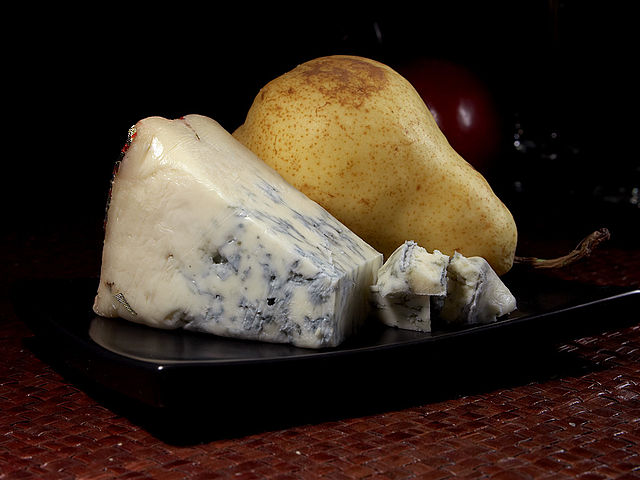
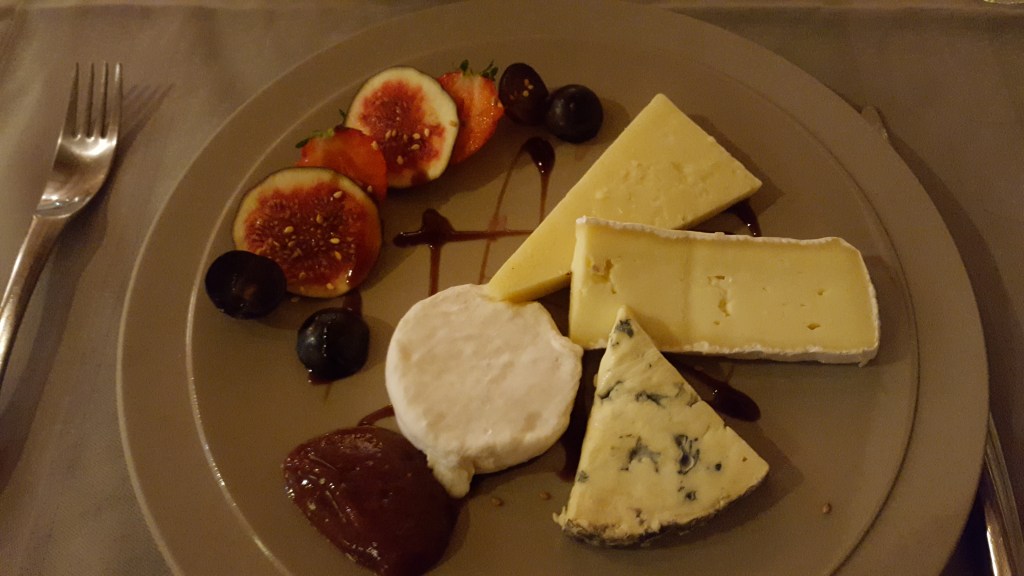
Blue lovers will notice a distinct lack of Gorgonzola in the list. It’s simply because that’s the one blue cheese we typically get in our house. Around the holidays, Whole Foods sometimes has a Gorgonzola Cremificata, so soft that they dig it out of the wheel with an ice cream scoop and put it in a deli container. It’s wonderfully creamy, a bit salty, and has a moderate but not overwhelming blue flavor. The two main styles of Gorgonzola are both a bit older. You can see them both here.
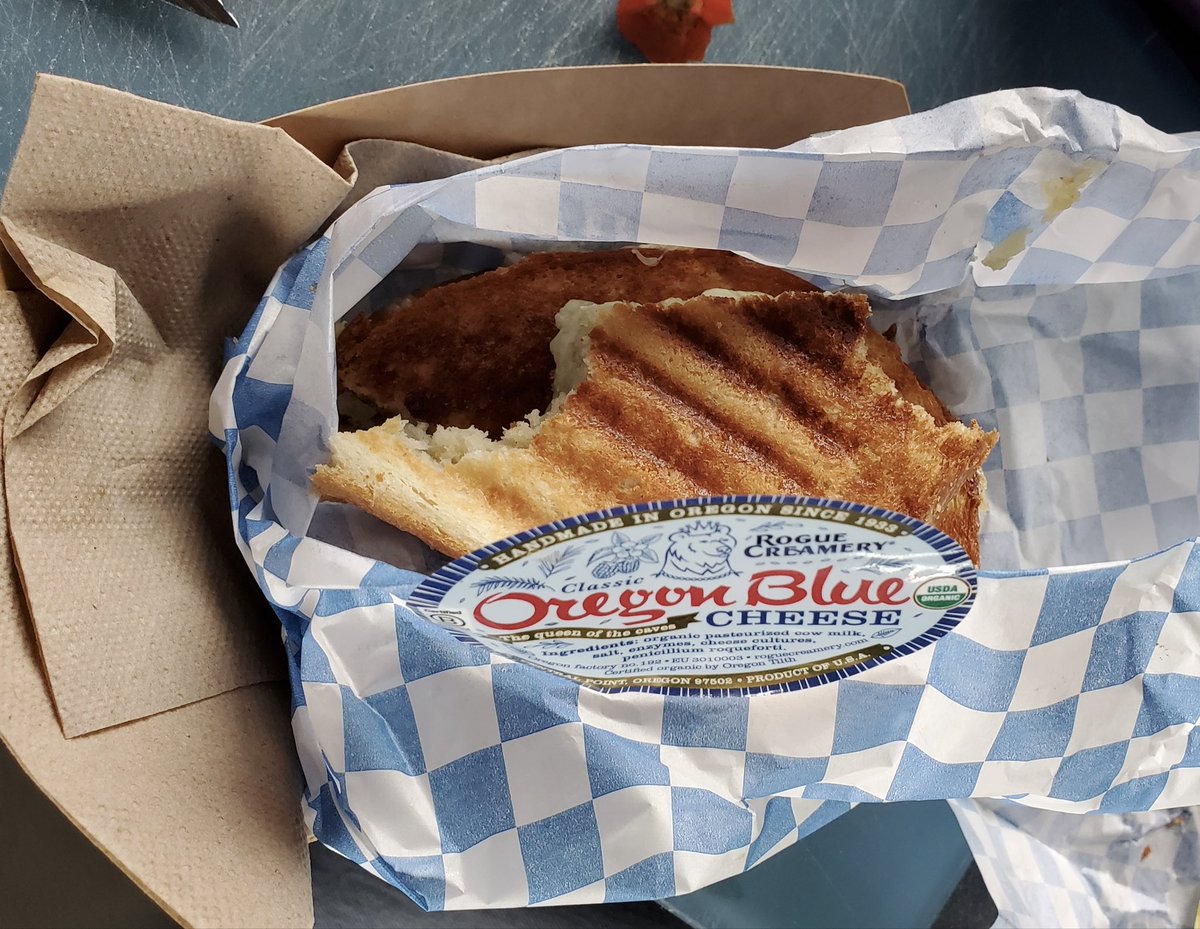
I must also mention the family of Rogue Creamery blues. Rogue Creamery is in Oregon, and their cheese shop is just off of I-5 if you happen to be passing through the state. They also sell grilled cheese sandwiches there. 😄 They have fairly wide distribution through Whole Foods and higher-end cheese shops, and sell online.
They’re best known for their large, leaf-wrapped Rogue River Blue, though my personal favorite is a milder blue smoked over hazelnut shells (“Smoky Blue”).
Blue cheeses pair well with dark chocolate, pears, red fruits, toasted nuts and dessert wines. The 10 Year white port we found when visiting Porto in May was divine with all of the cheeses! (The producer, Vasques de Cavalho, has been growing grapes for port for several generations, but started their own label only recently. They’re still fairly small, though easily our favorite of the producers we visited.)
Over on Twitter, a couple of folks commented on how little the slices seemed to cost. I had gotten very small slices, just enough for a couple of bites of each for each of the three of us. When you have 4-6 cheeses, that’s really all you want–cheese is rich and filling, and the especially with a plate with all the same genre of cheese, it’s easy to get palate fatigue. So for ~US$10–less than a Starbucks per person–we were all completely satisfied.
So: the evening’s cheeses <drumroll>:
The Jasper Hill is a nice mild cheese, but not much blue flavor or other noteworthy elements.
The Cambozola appealed to those of us who like softer cheeses. It’s a newer German cheese that blends the techniques for Camembert and Gorgonzola. The blue flavor was more of a hint than the main event, which may be a good or a bad thing, depending on your tastes. It definitely leaned more towards the Camembert, with a great, unctuous mouthfeel and butter flavor.
The English Stilton and the Point Reyes blue were the next pair. The Stilton was still not blue enough for the blue lover, but the anti-Roquefortian thought it was just right. She and I both appreciated that it still tasted creamy, even being a drier cheese. The Pt Reyes is supposed to be a Stilton-style as well. To my taste it’s fairly salty, with a crumbly texture. It was a bit more brittle than the English Stilton, with a stronger Blue flavor.
#5 was a French Fourme d’Ambert. It’s softer in texture than the Stiltons, but very salty with a very strong blue flavor. The blue lover was a fan, the rest of us not so much.
This was a blind tasting, but Ms Anti-Roquefort kept trying to identify the Roquefort in order to feel vindicated in her hatred. She had decided it must be #5 and #6, and was trying to decide which was more terrible in order to identify the Roquefort.
#6 was a very soft, creamy cheese, with medium salt and medium blueness, a bit of sweet roundness. I liked this one a lot, finding it very nicely balanced. The blue lover preferred Pt Reyes and Fourme d’Ambert. Ms Anti-Roquefort still liked Cambozola and Stilton best, but found #6 quite acceptable.
In this episode, we get acquainted with the various phyla of the cheese kingdom–the lactic sets, the bloomies, the hard cheeses, the blues and more: what they are, a few examples of each type and suggestions of what to eat and drink with each. Be prepared for your next wine & cheese event!
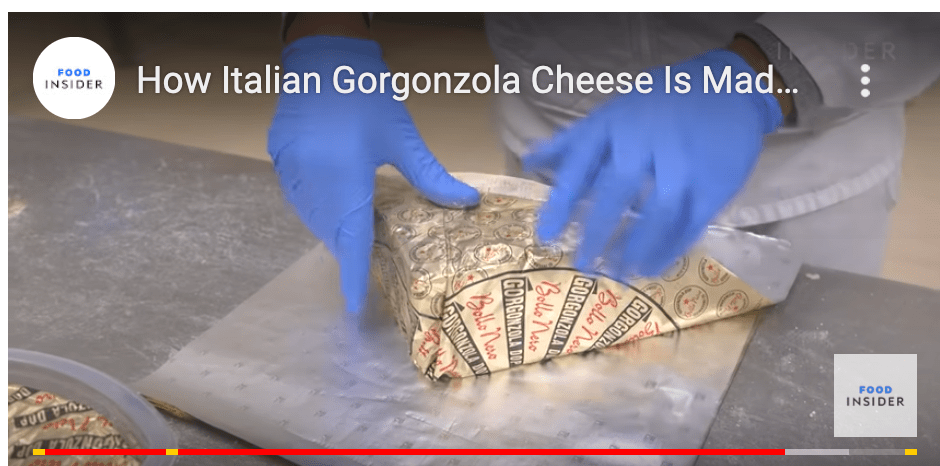
This video on how Gorgonzola is made makes the rounds pretty regularly. When I was first learning to make cheese, I found a lot of these videos interesting but kind of confusing–there’s a lot that goes unexplained. So here’s a thread of annotations!
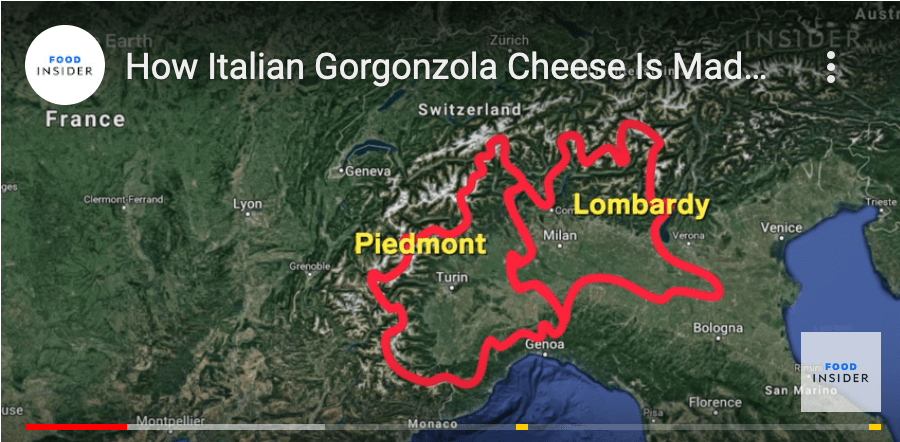
Here the narrator talks abt where the cheese “can be made”. It’s not that it literally, physically, can’t be made elsewhere, but the name “Gorgonzola” is protected under EU and Italian law, rather like “champagne”…
The EU Protected Designation of Origin (PDO, or DOP in Italian) and the national level DOC are extremely valuable certifications. In many cases the rules specify not only where the product can come from, but also the species of plant or animal that must be used in its production and sometimes, how it’s made.
The species & breed designations have been extremely important in protecting the economic viability of heritage breeds: because the PDO designation allows producers to market and charge for premium products, they can afford to use traditional breeds that may not be as high yielding as the workhorse breeds used by mass-market producers, but have unique characteristics that make them better suited to being raised sustainably in their traditional regions: they require less water for example, or they tolerate cold or heat especially well and can spend most of their time outdoors, or they’ve developed a resistance to local diseases and pests. Tl;dr the PDO scheme and earlier national ones play a significant role in preserving biodiversity in both plants, like wine grapes, as well as livestock.
The specifications about how a product can be made primarily protect the producer economically–it means that they don’t have to find endless ways to speed up their processes in order to stay profitable. But that economic support for slower production turns out to be meaningful on a microbiology level for fermented products like cheese. By allowing the microbes to do a slow, thorough job of working through the curd, we consumers get a greater range of flavors–which are the byproducts of the metabolization of fats & proteins–and also fewer of the proteins that can be inflammatory for some people are intact enough to cause problems. And for everyone, our own guts have to do less of that same breaking down & metabolizing work.
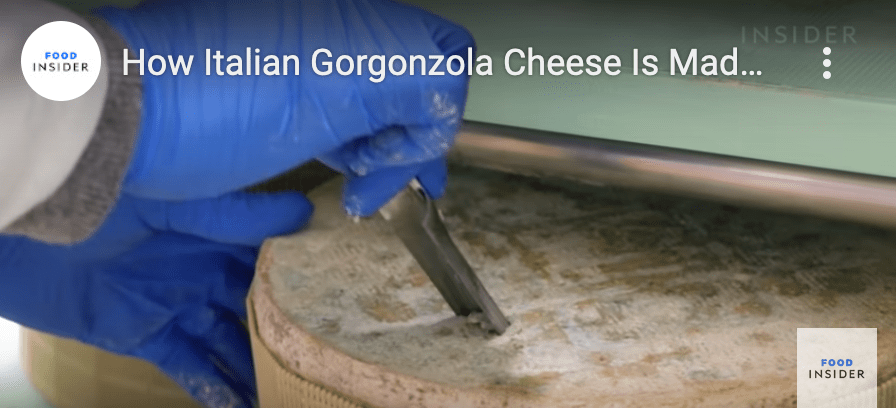
At 1:09 we see a tool is called a trier. You’ll see it a bunch of times throughout the video. It allows the producer to check on the state of the interior of the cheese without disturbing the whole rind or exposing too much of the interior to new things.
After they look at the sample, they carefully fit it back into the tunnel they made, and then seal the cut mark on the rind (traditionally with a smear of the cheese) to prevent oxygen and ambient yeasts from further entering the interior.
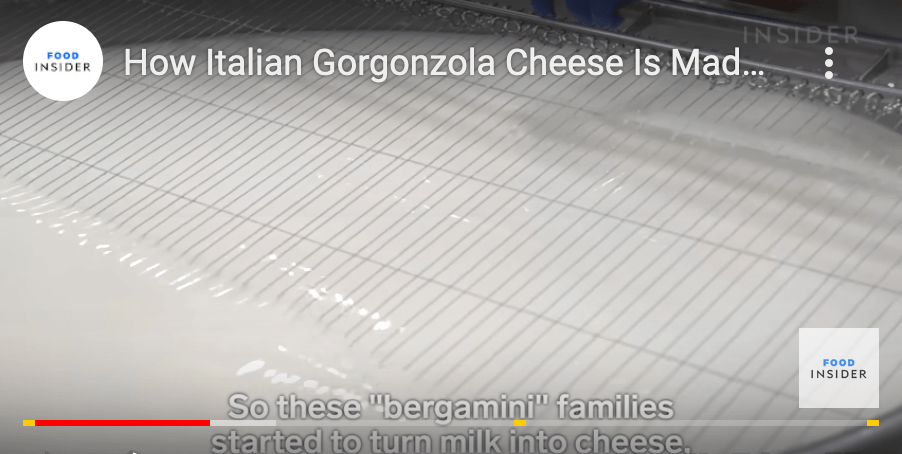
This tool at 1:57 is called a cheese harp. Once the milk has coagulated into a gel, it’s used to cut the curd into squares in order to release the whey.
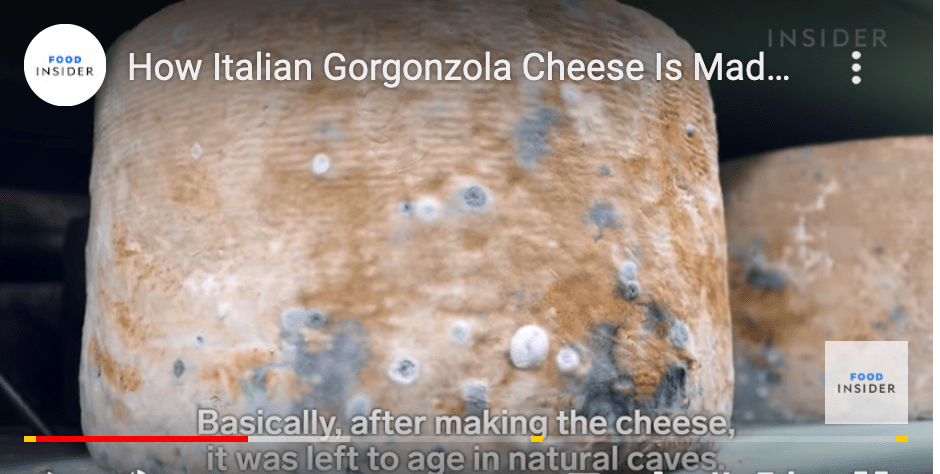
Americans are often weirded out by mold, but it’s absolutely part of the cheesemaking process, and its presence on the rind as the cheese ages is a big part of what flavors the cheese.
Producers will often brush off the ones that grow too tall, sometimes spot-treat any that they don’t want there. Big producers of long-aged pressed cheeses that normally have “natural rinds”–especially those selling to the American market–often slap a breathable film on their cheeses as it makes it easier to brush off “unsightly” molds and maintain even, pristine-looking rinds. But this is the opposite of how cheeses are normally aged, and it comes at the expense of complex flavor.
Here at 2:28 you can see a sort of plastic girdle around the center of the cheese. This isn’t something that’s used on every type of cheese. It’s just that these cheeses are both tall and very soft, and the girdle helps it stand up straight and maintain its shape during the aging process.
The same sort of thing is used on Vacherin Mont d’Or, a very soft, gooey cheese from the French Alps. I used spruce versions for aging my Spruce Button cheeses.
Here's the spruce girdle. It's made from the inner bark of spruce trees, which is a whole craft and profession of its own pic.twitter.com/eLT66G5GyL
At 2:51 they talk about the 2 different kinds of gorgonzola, the softer “dolce” and firmer “picante”. They start out the same, but one is aged longer. They don’t say in the video which is older, but it’s the picante version.
This is true for most cheeses: they dry out as they age and that intensifies the flavors. The exception are surface-ripened cheeses like bries and other bloomy rinds, where yeasts & molds work their way into the interior of the cheese, eating through the protein structures as they go.
At 3:32 they talk about penicillium roqueforti, the blue mold, being added to the milk along with the other starter cultures. P. roqueforti is the most common strain used in blue cheeses, but its cousin P. glaucum is used in some blues instead such as Bleu d’Auvergne and, in fact, some gorgonzolas. Glaucum is more of a grey-blue and has a slightly milder flavor than roqueforti.
But these are just 2 of many, many blue strains that exist in the wild, and there are numerous substrains within each of those. These are the ones that people decided they liked and isolated so as to ensure consistency in cheesemaking. The blue mold that grows on the bread you keep in a plastic bag may be one of these, or it may be a slightly different one. If I let my aging cave get too moist, I risk having it get colonized by my local blue mold–which is a purple-blue, and has an acrid peppermint flavor which can permeate a cheese even if it only gets on the rind.
The section from 3:37-3:42 is kind of confusing, because they just jump from adding starter cultures & rennet to liquid milk, and then cutting the coagulated curd, and it’s not obvious that time has passed. But at a later point they say it’s abt 20 mins.
At 3:45 we see the curd harp again. The worker does one cut, then walks 90 degrees around the pot to cut again, forming a checkboard of cuts so that there are evenly cut squares of curd throughout the vat.
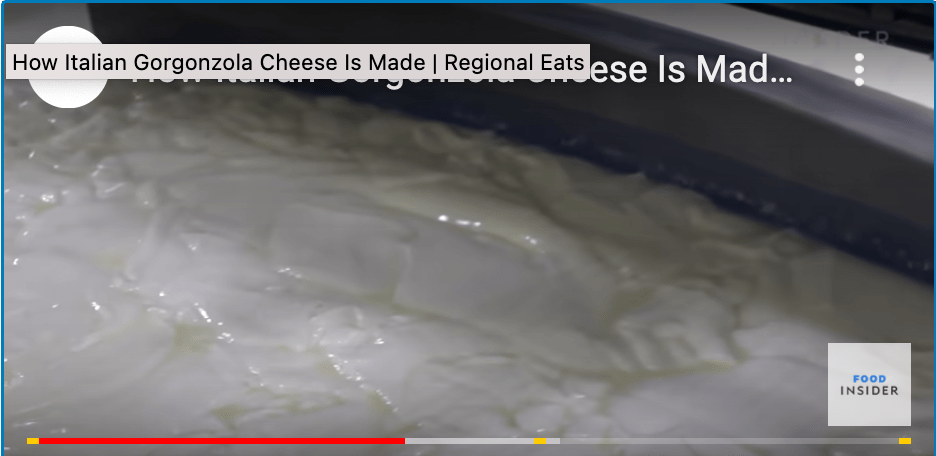
20 mins is not long at all, and as you can see at 3:52, the curd is extremely soft and delicate. If you watch other videos about harder cheeses, you’ll see the curds are often smaller, but also much firmer and easier to pick up.
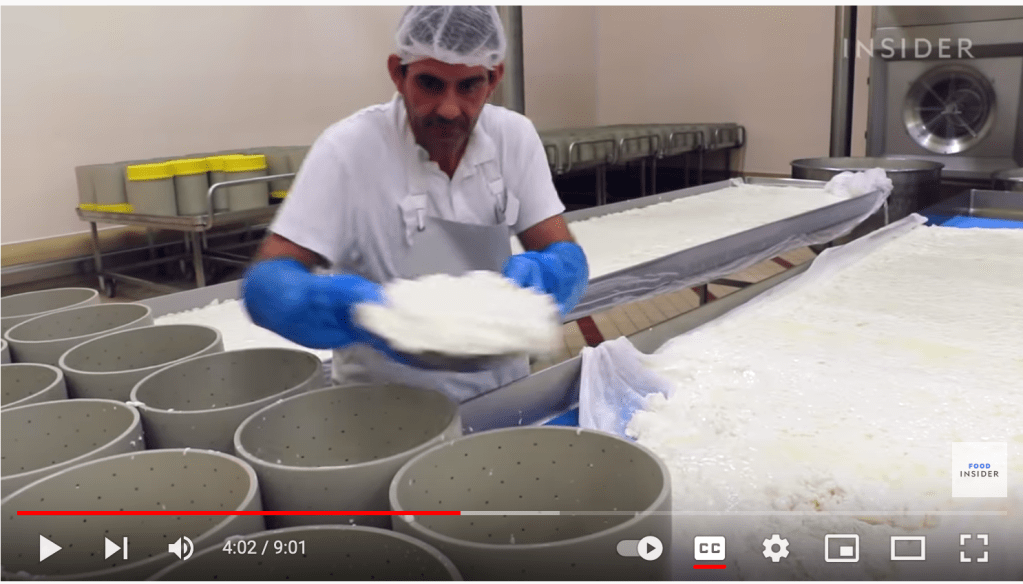
At 4:02 you see the workers scooping the curds up w/bowls and pouring them, whey and all, into the molds. Because these curds are so soft, they naturally slip together and close up open space left as the whey drains out the bottom.
At 4:30, the cheeses are left to drain overnight. People often assume these means they’re refrigerated, but that won’t happen for several days. The starter cultures need fairly warm temps–75-90F usually–in order to work on consuming the lactose in the milk and convert it to acid.
Acid means flavor. If you’ve ever had a really bland cheese, that’s a cheese where acid production is stopped at an early stage in the cheese making process. The salting shown at 4:34 is the point where that acidification is stopped the next day.
Stopped on the rind, in any case. There’s still stuff going on inside the cheese. There’s still lots of whey in the curd at this point, and the cheeses will continue to shed whey for several more days. The salt on the rind helps draw it out.
Whey flows faster at higher temps, which is why the cheeses then spend a few days in a “warm” room (usually in the 60s F). The picante versions spend more time there both to draw out more whey, and to give the mold spores more oppty to grow aggressively.
Puncturing: not all blue cheeses are punctured, but most are–and it’s pretty unique to blue cheeses. The holes in the rind are there to allow the blue mold spores access to oxygen as they’re starting to sprout.
These are still very young cheeses, though. The curd and rind are soft and still actively trying to knit together. So just like a cut on your skin, the holes will close up pretty quickly as the cheese ages. But by that time the mold spores will have gotten going. Because the cheese wasn’t pressed and the curds just kind of found their own places as they were placed in the molds, there are actually a lot of little open seams within the cheese, which allows the mold spores to effectively send out runners and spread thru the cheese. By the way, Cheesescience.org is a great resource for all the microbial details of cheesemaking for the Average Joe. He has a good article on the doings of P. roqueforti inside a cheese.
Finally, at 7:34, they talk about the foil wrapping. But in the video they mostly talk about it in terms of displaying the DOP designation I talked about earlier.
But there’s a reason it’s foil, and not some other type of wrapping: blue molds are REALLY aggressive. They will happily colonize anything given the chance. Many cheeses are wrapped in special papers or plastic films (think of that white paper around your Camembert) that allow the cheese to breathe as it’s transported from the manufacturer to a store.
But no retailer wants the blues colonizing the rest of their cheese case, and you don’t want them doing that to everything else in your fridge. So, just as tinfoil hats are good for keeping your thoughts from getting out to Them (whomever you’re afraid of), foil is used to keep your blues contained. /fin




 Into The Curdverse