Bloomy Deep Dive: Traditional Camembert

Here’s a lovely video about how traditional Camembert is made, which very nicely illustrates a number of the things I talk abt in Episode 7.

One thing I didn’t specifically mention is that as with many cheeses, the AOP version must be made with milk from a specific breed, in this case the Normande cow. You can see some in the background at :13: mostly white with dark red splotches.
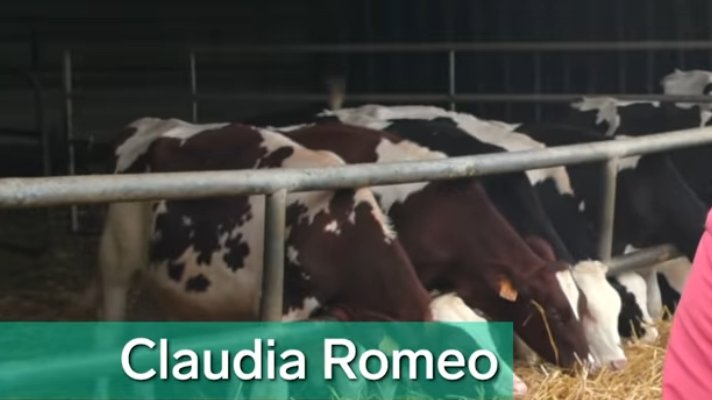
The Normande breed produces high protein, high fat milk–4.4% fat on average, vs 3.25-3.5% from the typical Holstein.

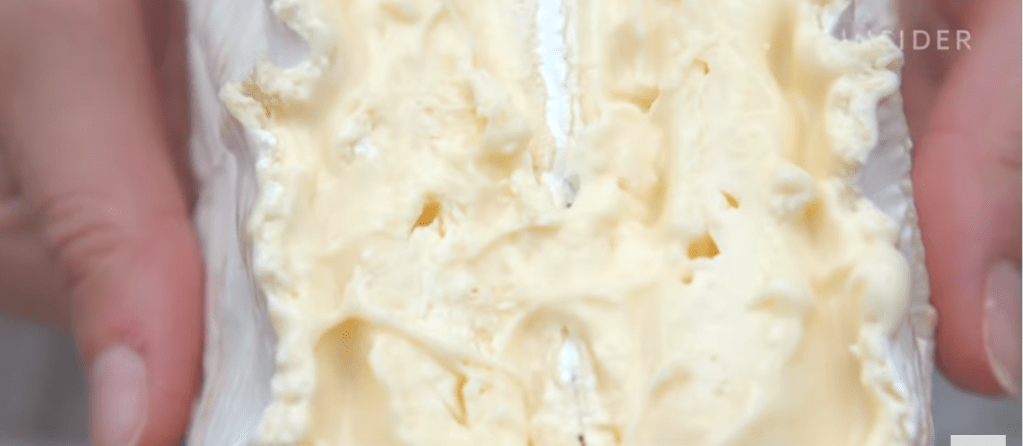
At 1:17 we get our first glimpse of the interior of a traditionally made bloomy rind. Unlike the stabilized paste cheeses typically available in supermarket, the texture is not even throughout the cheese. That’s because it ripens from the outside in.
At 1:35 the maker talks about the “croûte fleurie” of the cheese. That literally means “flowering crust”, referring to the fruiting of the geotrichum & penicilllium fungi on the rind. The slightly more indirect translation in English is “bloomy rind”.

Fun side fact for those who don’t speak French: that little “hat” mark over the U in croûte is called a circumflex, and it marks where there USED to be an S, which at some point stopped being pronounced in French, and then much later orthography caught up with pronunciation. We often have the same word, with the S, both in writing and in speech, in English: croûte = crouste = crust.

In the podcast I mentioned that most of these bloomies were originally farmhouse cheeses, things that didn’t require a lot of hands-on work that would tie down the farmwife (typically) as she ran around taking care of all of the OTHER business of running a farm & household. So a lot of these cheeses are traditionally made from raw milk that’s just left to sit around and acidify on its own for 12-24 hours. (Longer if it’s cooler, less time if it’s warmer.)

Discussion of acidification process above

Some bloomies are entirely lactic set with very little rennet–many of the goat cheeses, and also Brie de Melun. Others, including most other types of Brie and also Camembert, get more rennet added (as at 2:29) for a bit more structure to the curd.
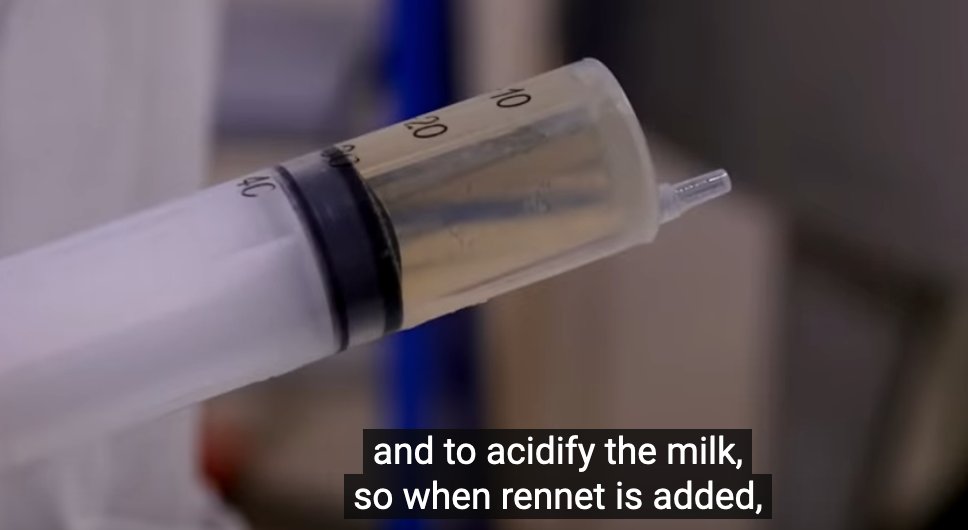
Note that the raw milk is never heated: it just comes out of the animal and is left to sit in buckets or forms as it acidifies. The French often categorize cheese by dividing them into “cooked” and “uncooked” cheeses for this reason, and then “pressed” and “unpressed”.

At 2:32 we see the curd being cut into quite large chunks. This allows the curd to retain a lot of liquid, which will help it break down quickly over a few weeks.
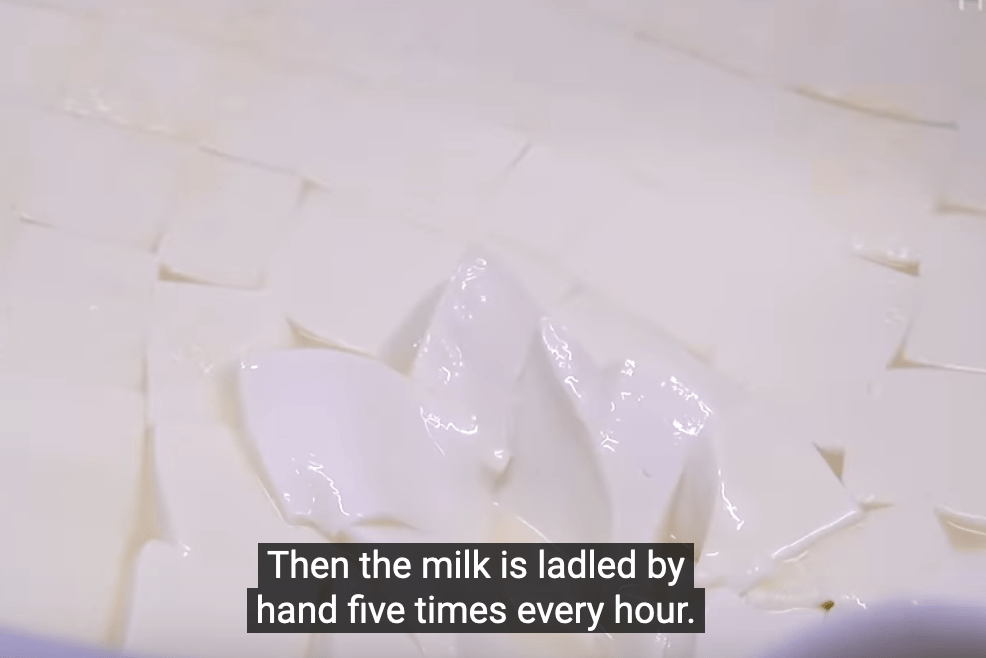
The curd is barely stirred, if at all, so it hardly retains its shape as it gets ladled into molds. As the maker notes at 2:42, each layer of ladling (one ladle per hour into each mold) condenses from a full mold into a thin layer over an hour, as the fragile curd blocks quickly collapse. Camembert molds are simply round cylinders with holes on the sides and no bottom. The whole goal is to allow the whey to drain out without any impedance.

Here you can see the curds collapsing and flattening as they shrink down into the mold.
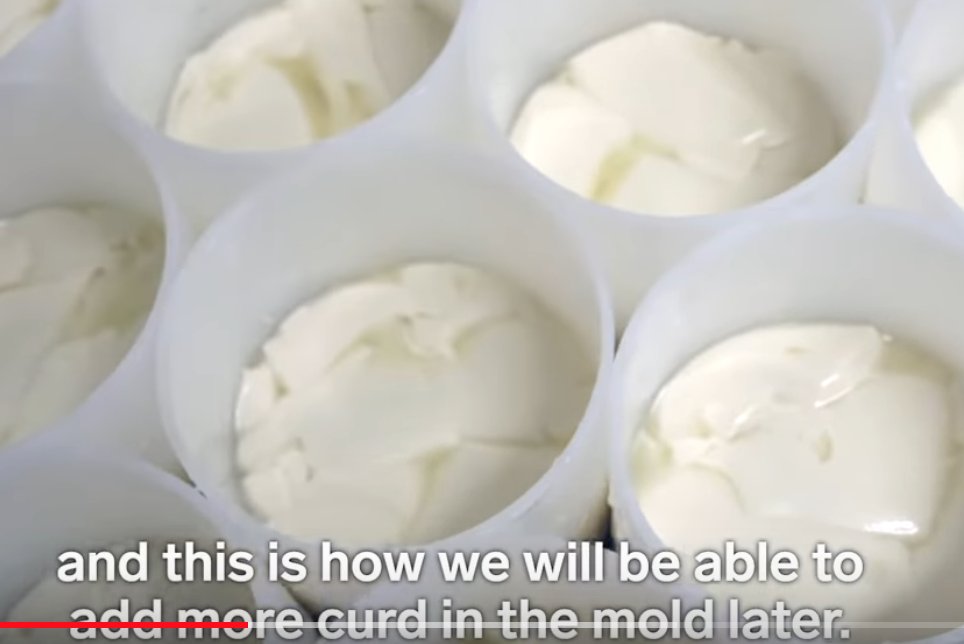
In case you’re wondering, yes, a little bit of a skin does develop on the top of each layer during the hour between ladlings, as the top portion, exposed to the air, dries out a bit. At 3:33, the maker pulls on the sides of a day-old cheese to show how the layers can be seen. The cheese is unpressed other than with the weight of new curds being added on top of others, so they aren’t tightly knit together.
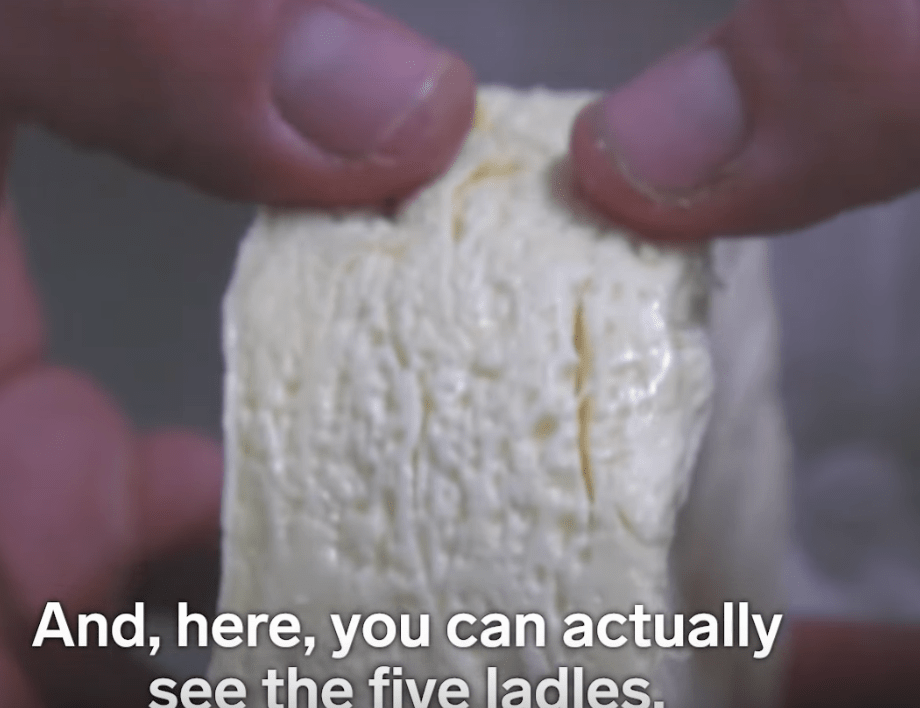
At this point it should become clear that this approach, while wonderfully low-key from the point of view of someone with a million other things to do in a day–18-24 hours to acidify, another 30-45 minutes to coagulate, 5 hours to mold, just stopping by every now and then and then going on about other business–is completely antithetical to mass production, where high throughput is king. So mass-market cheeses are made with lots of added cultures to jumpstart acidification; the molding/draining process is also done at a warmer temperature, so curds drain faster. It’s the opposite of “low ‘n slow”.

Around 3:45 they talk about the aging time, 4-5 weeks, which allows the fuzzy white molds (fungi, really) to grow in on the surface and then work their way into the curd. Here you can see cheeses a week or so old, when the rind is just partially grown in. It comes in patchily at first, then starts to spread until you get a fairly even coat.

The maker mentions at 3:57 that they add geotrichum and penicillium. Sometimes freeze-dried spores are added to the milk as it’s acidifying; in other cases, especially large productions, they can be added to brine that is sprayed on the surface of the cheese after it’s made. Because there’s less of the fungi active in the curd, this enables the producer to have a nice traditional-LOOKING cheese, but less outside-in aging, which would produce a less even texture.

Towards the end of Ep 7 I talk about how to select a cheese in the supermarket. One thing to look at is the evenness of the rind. Some bloomies are sold, honestly, too young, and never really soften well in your fridge. Others, especially imported ones, are often older than ideal. You can decide for yourself what the sweet spot for you is, depending on how quickly you eat your cheese. If it’s for a party tomorrow, buy an older one. If you just have a few slices every few days, buy a younger one.

At 4:06, we see how in older cheese starts to develop “bald” spots, where a beige rind starts to show through.
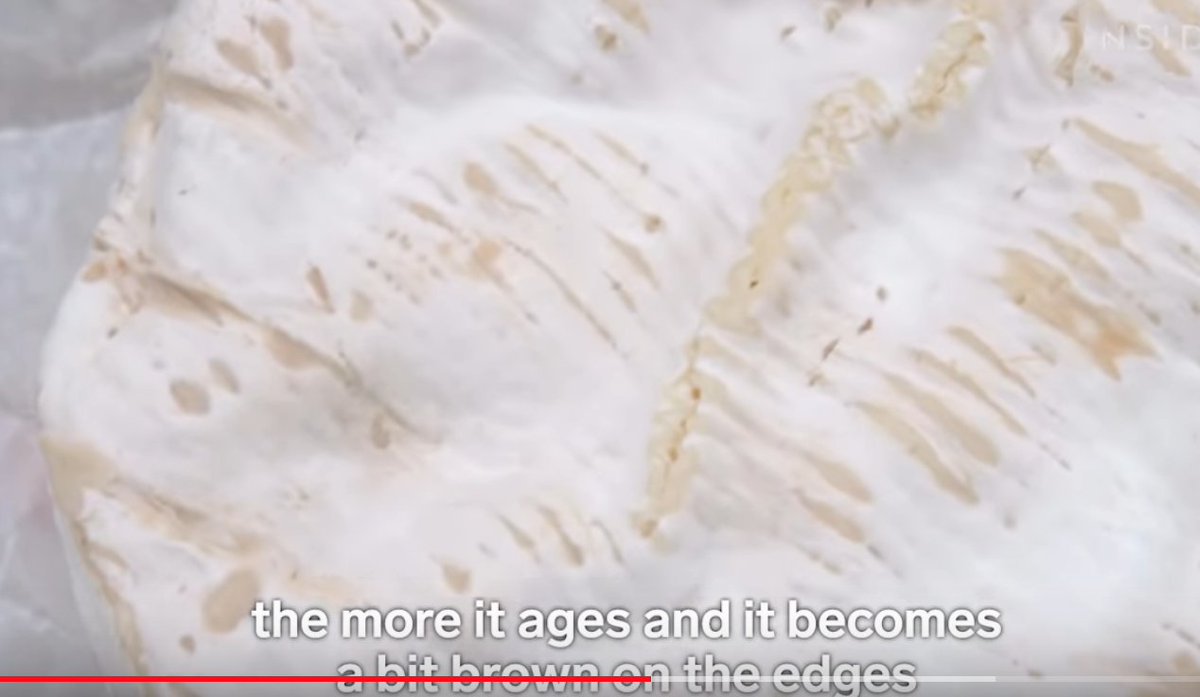
At 4:10 we get a closer look at the inside of a traditionally ripened bloomy: crust about the texture of wet cardboard, oozing paste just inside it (called the “cream line”) and then a still-firm, cakey-textured center.
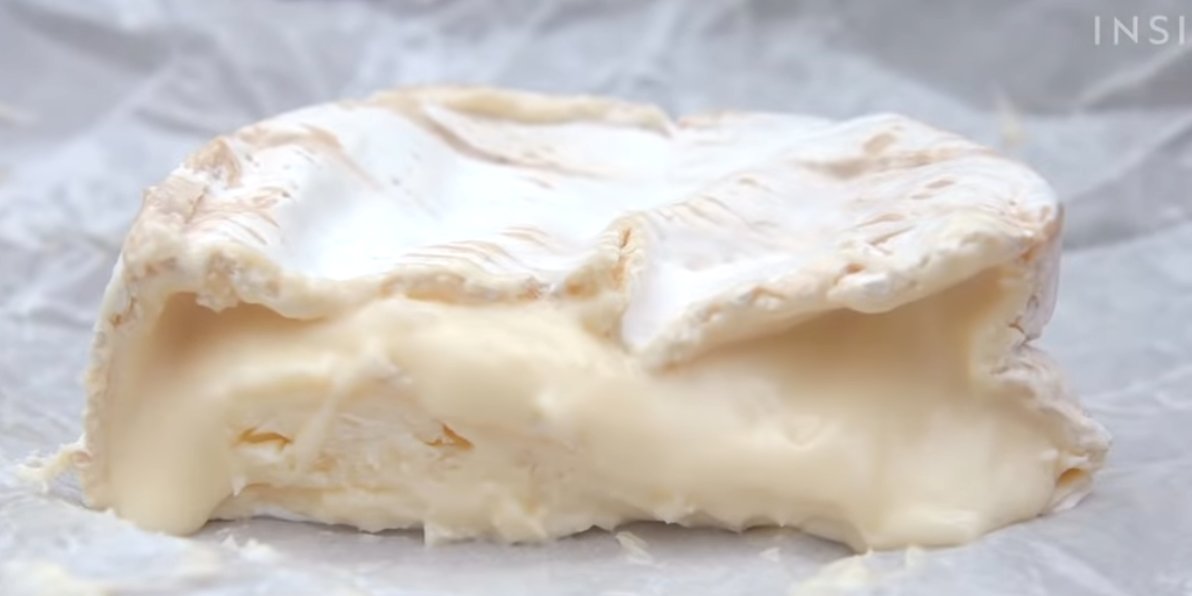
This is obviously quite different from the stabilized-paste bloomies we typically get in supermarkets. I talk about how stabilized paste is different in virtually every aspect of how it’s made towards the end of Ep 7.

So if you see something with these multiple textures, you’re getting a cheese made fairly traditionally–but you’ll want to eat it quickly. If it’s uniformly firm, with no “squish”, it’s a stabilized-paste and either extremely young, or one of the brands that never really softens.

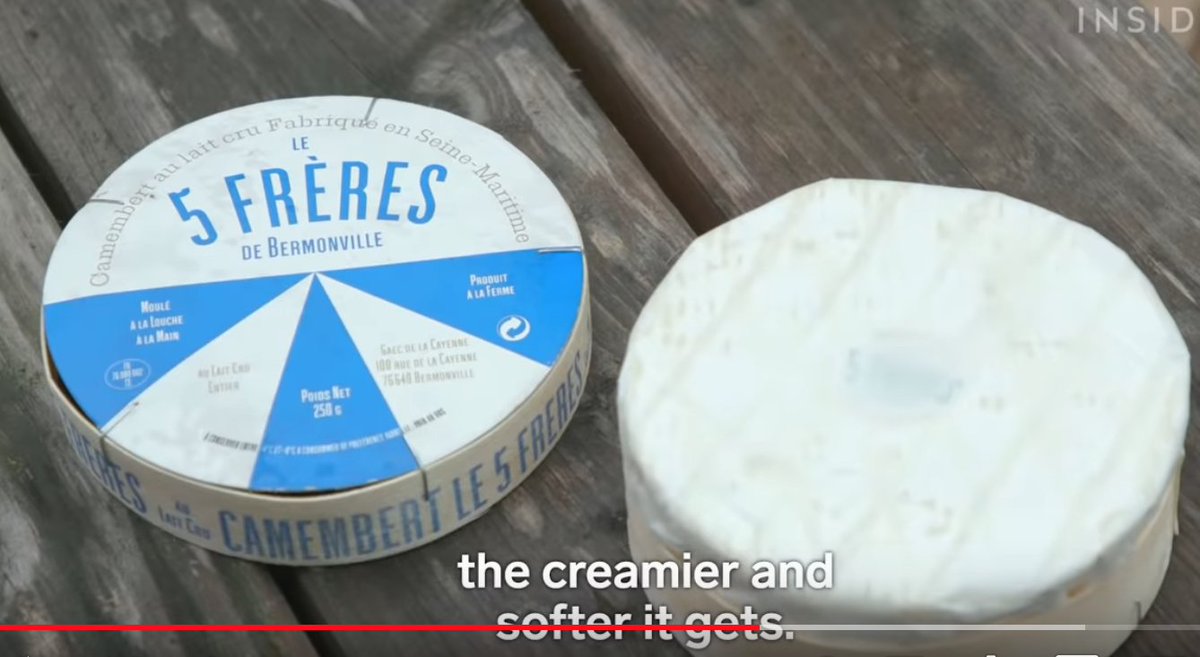
Around 4:33 the maker talks about the traditional wooden box in which Camemberts are often sold: it helps the cheese keep its shape as it softens and ages, and protects it from getting squished during transport.
A number of soft-ripening cheeses are packaged this way, in fact…St Marcellin, a bloomy with a very thin rind, is often packed in small ceramic pots because it gets runny so easily.
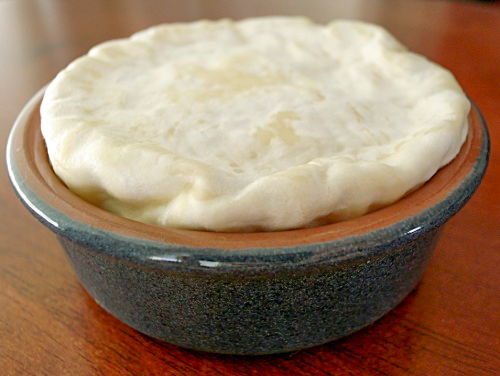
Source

Livarot, another Norman cheese (washed rind, not bloomy) that’s probably older than Camembert, is taller and traditionally tied twice around with raffia to help it hold its shape.
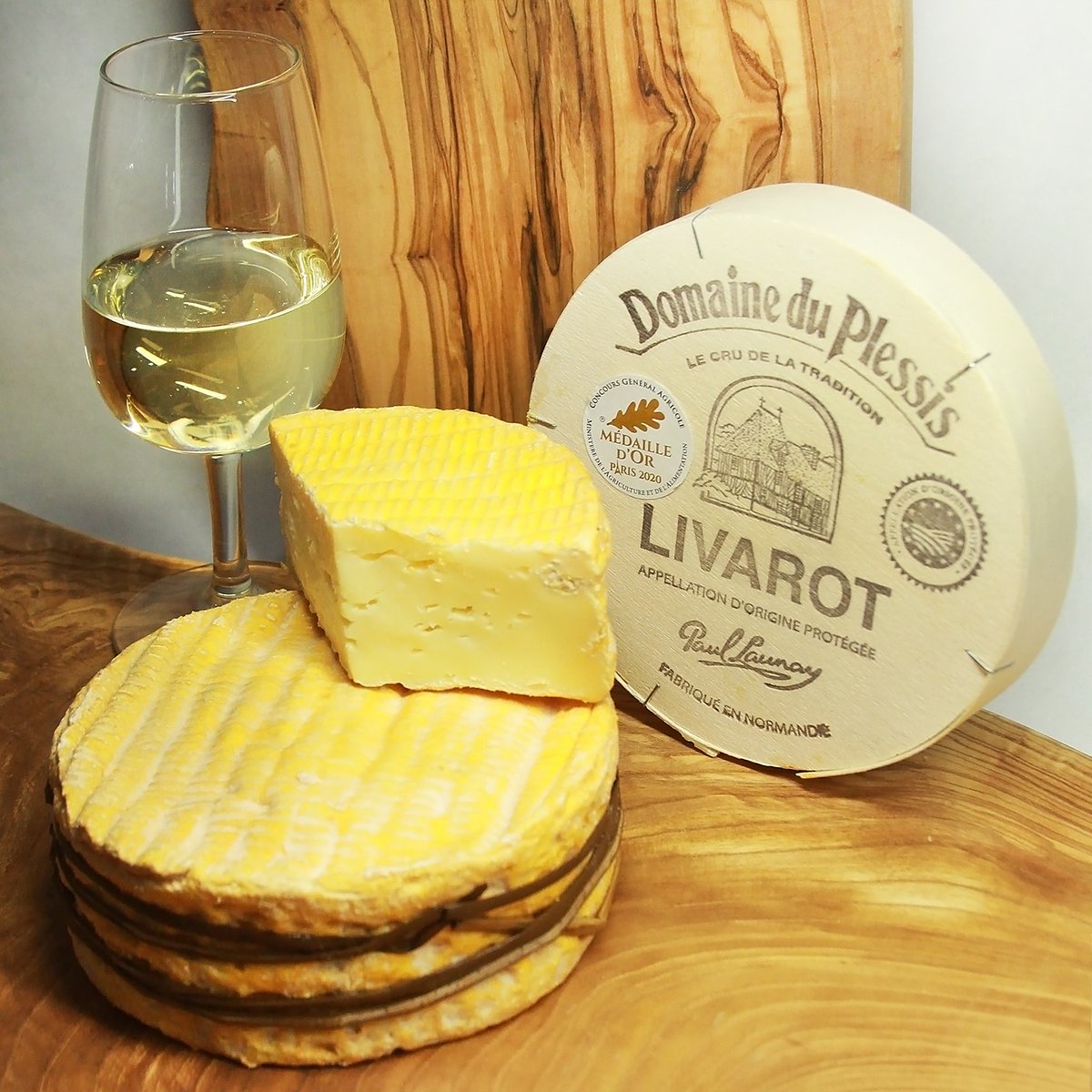
Source

Around 7:11 they mention that most of the Camembert made today is made with pasteurized milk. Only ~10% of Camemberts are made the way we’ve just seen, with raw milk. Because of the very long production time for the traditional approach the AOP label is extremely important commercially for small, traditional producers–it allows them to differentiate their product and maintain a price premium that allows them to stay out of the red financially.

The label, however, is a subject of much controversy, as the government has broadened the label in different ways several times. Here’s a discussion of one of the more recent contretemps…which, because it’s France, led to protests that included traditional Camembert cheeses being dropped in MPs’ letterboxes.

All of this is neither here nor there for those of us in the US, since 4-5 week old, raw milk cheese can’t be imported here. But if you’re touring around France, enjoying Euro-dollar parity, you may wish to look for “fermier” on the label in a proper cheese shop to get the full flavor experience of a traditionally made Camembert.

Originally tweeted by IntoTheCurdverse (@curdverse) on July 17, 2022.
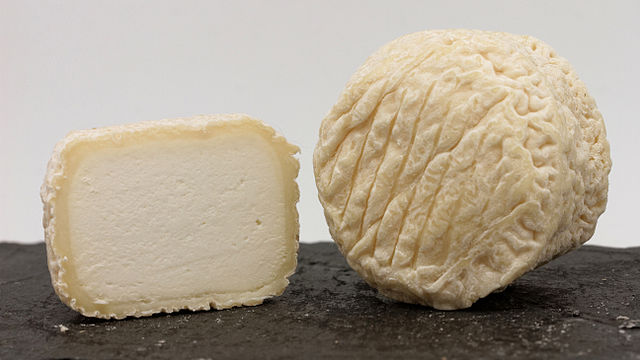
Ep 7: Beyond Brie – The Bloomies

Goat crottin

Brie shows up on pretty much every catered cheese board because it’s usually mild and has a nice mouthfeel. But there’s more than Brie in the world of fuzzy-rinded cheeses! Start venturing off the beaten track–whether with a triple-cream Brillat-Savarin or a goaty Valençay. Learn how to choose a good one–not too young, not too old–and how to serve it.

(Re)sources

Enormous list of bloomy rind cheeses to explore

Annotated video of traditional Camembert production, showing you what to look for

Full text of Charlemagne story (in French)

Geotrichum: the yeast that acts like a mold

Image: Goat crottin, via Wikipedia. Sound effects from Zapsplat.com. Smooth jazz snippet is drawn from Night on the Docks via Wikimedia.

The Wonderfulest Thistle

There’s a tongue-twister in English about “Theophilus Thistle”, or as I pictured it as a child, “The Awfulest Thistle”:

Purple cardoon thistle in bloom
If Theophilus Thistle, the successful thistle sifter,
In sifting a sieve full of unsifted thistles,
Thrust three thousand thistles through the thick of his thumb.
See that thou, in sifting a sieve full of unsifted thistles,
Thrust NOT three thousand thistles through the thick of THY thumb.

It kept coming to mind as I toured Portugal last month, since the Portuguese have a special fondness for using thistle rennet in their cheeses. (I talk a lot more about this in Episode 6.) They’re not the only people to do so, though: their neighbors in western and northern Spain often do as well. The rennet can be made with the purple stamens of the flowering thistle, but the leaves of some plants also contain the same protein-metabolizing enzymes. And these have an effect on a very different cheese made far to the north of Iberia: Cornish Yarg.

Yarg is not common on North American cheese counters, but it’s a somewhat famous oddity in the cheese world due to being wrapped in nettle leaves

There are a bunch of cheeses that get wrapped in leaves—fruit and nut tree leaves are more common though.

Nettles themselves aren’t a common food in North America, but have been used much like other leafy vegetables all over Europe for thousands of years. They happily grow wild in many places that are difficult to farm, which has been important for people living on marginal lands.

In such places, where plant cultivation is minimal, livestock agriculture is key to subsistence. And in most subtropical regions of the northern hemisphere, that also means a diet heavy in dairy and cheese, as those are more renewable sources of protein than meat.

How useful, then, that nettles and thistles can also coagulate milk! No need to kill very young animals that don’t have much meat on them and then have to cure their stomachs while (in some regions) following your herds in a foraging circuit, with no fixed house or barn. Unlike animal rennet, plant rennets are relatively easy to make at need and don’t require long-term storage.

But you’ll often see comments about plant rennets making cheese bitter as they age. And it’s true that plant-rennet cheeses today are most commonly found in traditionally hardscrabble regions, cuz who would want to eat bitter cheese if they didn’t have to?

But this bitterness claim didn’t exactly jibe with what I found in actually eating a range of Portuguese cheeses last month, virtually all of which are made with cardoon rennet. No bitterness even in the harder ones. So is this bitterness trope just a snobbish old wives tale?

Upon further digging I found the key to the “bitterness” claim lies in the type of milk used: in Ep 4 I talked a bit about how milk from different species are structurally different. The range of flavors that cheeses develop as they age is a byproduct of the breakdown of the fats and especially proteins in the milk. And in Iberia, especially in the places fond of using cardoon rennet, they mostly make sheep and goat cheeses.

I’m going to get gross here for a minute. You know how different people in your family have different- smelling farts even though you all eat the same food? It’s because each of you has your own unique set of gut bacteria, which break down your food in slightly different ways. Each metabolizes different parts of the compounds in your food, some more efficiently than others, and with different byproducts as a result. Same thing with the cultures and rennet in your cheese. Cow milk in particular often contains more long-chain proteins than sheep or goat and its proteins can produce a set of bitter peptides under the influence of cardoon (thistle) rennet, while sheep and goat milk do not.

In Ep 2 I talked a little bit about rennets, about how in mammal stomachs we have two major enzymes, chymosin and pepsin, that do the first-pass food breakdown. With animal rennet, the source animal is slaughtered when the ratio is mostly chymosin. Pepsin is a much stronger enzyme that comes to the fore as the animal starts to consume solid food.

Plant rennets have no chymosin, and unlike animal rennets, which exhaust themselves fairly quickly, leaving most of the long-term aging to the remaining cultures, plant rennets keep going and going…

Energizer bunny gif

So you get faster, more aggressive proteolysis, or protein breakdown, with plant rennets.

But back to yarg: although it’s typically made with cow milk and animal or microbial rennet, it’s often soft and creamy on the outside, directly under the leaf wrapping, and firmer/crumbly in the interior. That’s because the nettle leaves are breaking down the part of the cheese they’re in direct contact with, faster than the enzymes present in the rest of the cheese.

Originally tweeted by IntoTheCurdverse (@curdverse) on June 18, 2022.

ADDENDUM

I thought I’d add a pointer to US-made nettle cheese I had the pleasure of meeting a few years ago: “Nettlesome” from Valley Shepherd Creamery in New Jersey. Although they’re primarily a sheep farm, this particular cheese is a Gouda-style cow milk cheese. Finely minced nettles are mixed into the curds, giving it a slightly vegetal flavor and just a bit lip-tingly experience. I’d suggest pairing it with a dry cider, like Stella Artois. The carbonation and fructose balance out the nettly-ness.

It’s sold in certain specialist cheese shops (we found it in the store at Cowgirl Creamery), but they also sell direct–you can order from them online.

Ep 6: The Portuguese Curdverse

Portugal has a somewhat unique cheesemaking culture, heavily centered around sheep milk and thistle rennet. The unusual properties of each work together as if they were made for each other–and produce cheeses with a focus on the inherent flavors of the milk and juxtapositions of texture.

Images:

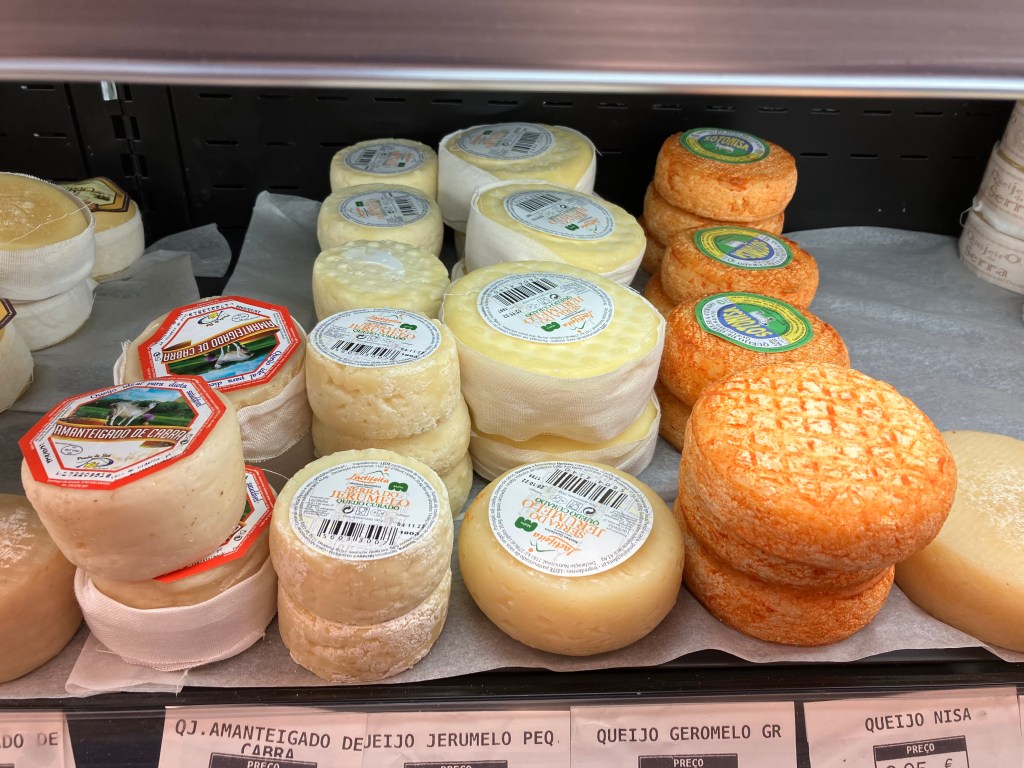
Cheeses of Southern Portugal in a Lisbon supermarket (top)

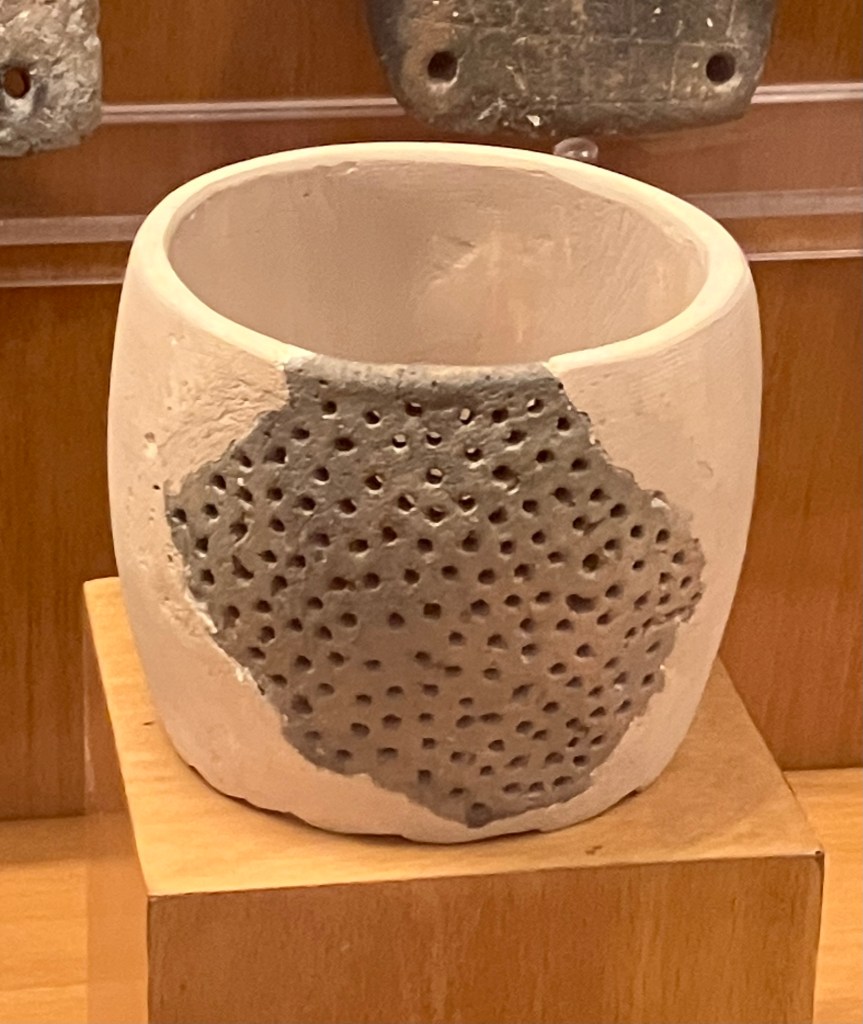
Copper Age cheese mold or strainer, Archaeological Museum, Lisbon (bottom)

Ep5: Cheeses of the Season – Spring

Milk is seasonal! And so is cheese. In this episode, we talk about how milk varies throughout the year, and a few cheeses that are at peak tastiness right now.

Show notes

Why milk seems the same year-round even though it isn’t naturally so

The relationship of feed and circadian rhythms in milk composition

A Tale of Two Cheeses – an illustration of the differences between winter and spring milk

Some spring cheeses to try – suggestions from a cheesemonger

Leaves in Cheesemaking

Cheeses mentioned in the show

Young goat cheeses: banon, cabecou, chabichou de Poitou, chavignol

Hard cheeses: Graviera, Manchego, Cantal, Ossau-Iraty, Salers

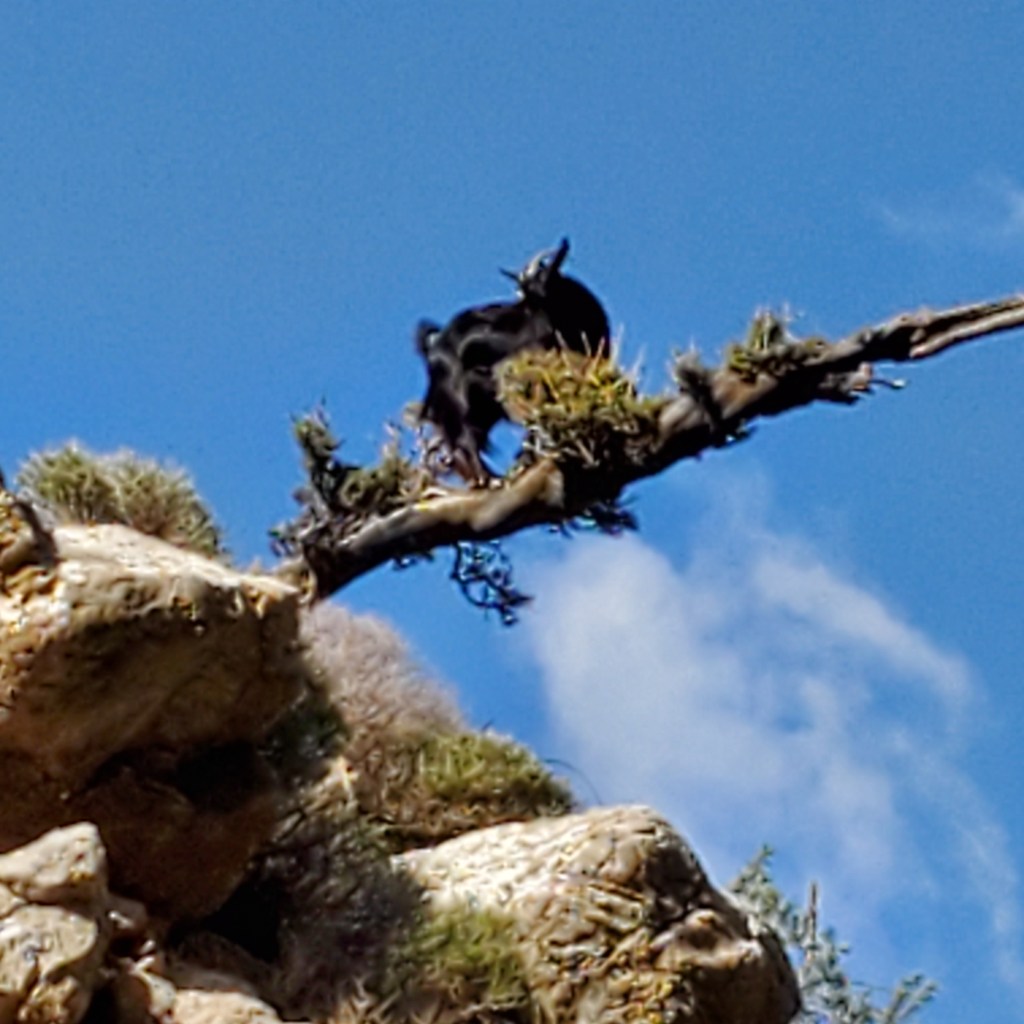
Goat on a tree limb

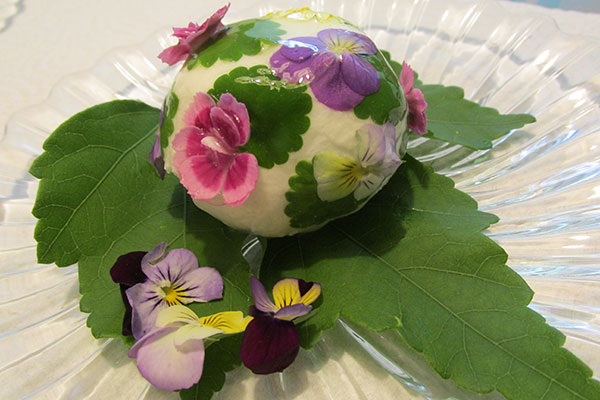
Flower-coated cheese image from A Better Whey blog

Music (Vivaldi La Primavera and Greek folk music) via Wikimedia

Cretan goat out on a limb in the Zakros Gorge image via Lisa Caywood

Honey-Rubbed Montasio

About six weeks ago, I started a Montasio, a mountain cheese from the Veneto-Friuli region of NE Italy.

I’d made it before, a very long time ago, and found it uninteresting, so I didn’t make it again. But! I came back to it last month because of a somewhat unusual finishing technique it sometimes receives: it’s coated with a few layers of honey in the early stages of aging. And I got this really interesting desert wildflower honey when I was in New Mexico that I thought would be great with the slightly nutty flavor of this cheese.

Let me explain about the honey.

Honey GIF

There are a number of long-aging cheeses where you oil the rind, creating an anaerobic barrier between the actual cheese surface and the surrounding air to help ward off molds.

Honey does the same, but it's got some even more interesting things going on:

Honey is pretty acidic. Actual pH varies quite a bit, but average in the upper 3s and low 4s. That makes for a pretty unfriendly surface for acid-sensitive microbes, yeasts and molds, of which there are many. You may have heard of honey being used on diabetics’ foot injuries; the combo of oozy spreadability (easy to get into small nooks and crannies)the acidity, and the anaerobic nature of the substance all make it a great way to seal off wounds from harmful microbes.

Now here’s the interesting thing about honey-rubbed Montasio: the first records of it come from a Benedictine monastery in the 13th c. That’s not to say that it didn’t exist before then, by any means. But it’s often aged for a really long time, and especially before the modern era, the people who had the real estate to age things for months or years, in the forms of caves & cellars, were the nobility and the Church. It’s why certain monastic orders are known for wine, cheese and beer: these were major sources of income for monasteries, which were often expected to be financially self-sufficient.

Honey, prior to the introduction of sugar cane & refined sugar from the Islamic world in the late middle ages, was pretty much the only source of sweetness in Europe. And it was a luxury item.

So guess what another major source of income for large manorial & monastic estates was? Honey.
So our Benedictine friends in NE Italy evidently had not only livestock, but also beehives. You can absolutely age Montasio without honey–oiling it, for example. But you might imagine that just like any modern enterprise, they may have had several different models in their product line, and the honey-rubbed version may have been the top of the line.

Some sources I've read also say Montasio was originally a sheep-milk cheese, or sometimes mixed-milk, but commercial versions I've seen, at least in the US, are all cow milk. So I'm making cow today. I may make it again with sheep milk some other time.

This is a fairly straightforward thermophilic cheese: heat the milk to 95F, add cultures, let them “ripen” or acidify the milk for 30 minutes, then add rennet and let it coagulate for another 30 minutes.

Also as it common with thermophilic cheeses, because you want to let a lot of the whey out, you cut the curd pretty small, .5cm. Then you cook them some more by slowly heating them to 110F over 30 mins, stirring slowly all the while.

After that, I turned off the heat and let the curds sit in the hot whey for another 30 mins, stirring every few mins, until the outsides were quite dry and not sticking to each other, and the individual curds were quite springy instead of squishy. Rubber band consistency.

Once the curds are cooked to the right consistency, you drain them and then press at about 20 lbs for an hour. Then lip the disc and press them for another 30 mins at 30-35 lbs, keeping them reasonably warm, 75-80 F, while they knit. The heat helps with the knitting process. The final weight of ~45 lbs stays on overnight.

Two other recipes for Montasio I have call for salting the curds before you put them into the press, which largely stops acidification. This one acidified for basically 18 hrs before I brined it the following morning.

Those other recipes also use 4-8x as much culture as this one. 🙂 So this is the very definition of low & slow fermentation. I’ve been liking the results of the low & slow approach better, which is why I opted for this one.

This is the baby Montasio just after being turned in its brine; it was there for a total of ~8 hrs. The final cheese is a bit salty, so I might do it for a shorter period of time next time.

After a couple of weeks of aging in the cave, the rind is fairly solid but not yet growing mold. That’s when the honey went on, 3 coats in all, drying for a day or so in between.

The honey is one I picked up on a trip to New Mexico. The Santa Fe Honey company is run by an extended family who has some 200 hives around the state. The majority are in the Rio Grande Valley, but some (like this one) are from the high desert and mountains. It’s got a dark caramel flavor with a hint of sage.

After a total of 6 weeks of aging, I can say that this Montasio is definitely better than the other ones I’ve made—mostly due to the milk, I think.

The last two I made were with standard supermarket milk and had that one-note sharpness of a lot of mass-market harder cheeses. This one is from raw Jersey/Brown Swiss milk, and has a richer, more buttery flavor. The honey on the rind isn’t really noticeable on its own, but if you eat slowly you get hints of the dark caramel along with the butter. It’s a fairly salty cheese, more than it is a sharp one.

Adding a dab of that same desert honey on a slice of the cheese makes all the flavors really bloom.

Ep 4: When Dairy Doesn’t Love You Back

Think you’re lactose-intolerant? Maybe, maybe not. Think being lactose-intolerant means you can’t eat cheese? Maybe you can.

In this episode, we talk about the various forms of dairy sensitivities, how the cheesemaking process transforms milk to make it more digestible, and what options you may have when dairy doesn’t love you back.

Sources and resources for this episode:

Post image and sound effects from Wikimedia

Milk Is Seasonal: A Tale of Two Pecorinos

I was unable to source sheep milk for quite a while, so when I finally found a new source last spring, I promptly made a “young pecorino”, a semi-hard table cheese, which was great eating until it was about 6 months old, at which point it became an equally excellent grating cheese. I just finished the last stub of it last weekend.

I started a second one in early January for the sake of having more Eating Pecorino, having made another smaller sheep cheese in “cobblestone” form a week earlier. Winter milk has more fat than spring and summer milk across all species, but this turned out to be especially pronounced in sheep milk, which is a high-fat milk to begin with.

Here’s a picture I took of the two cheeses side by side, when the winter one was just out of the press and being salted (that’s kosher salt on the rind–you brush it off when you’re done salting). This winter one is ~30% taller. Same recipe, same farm for the milk, both made from 2 gallons of milk.

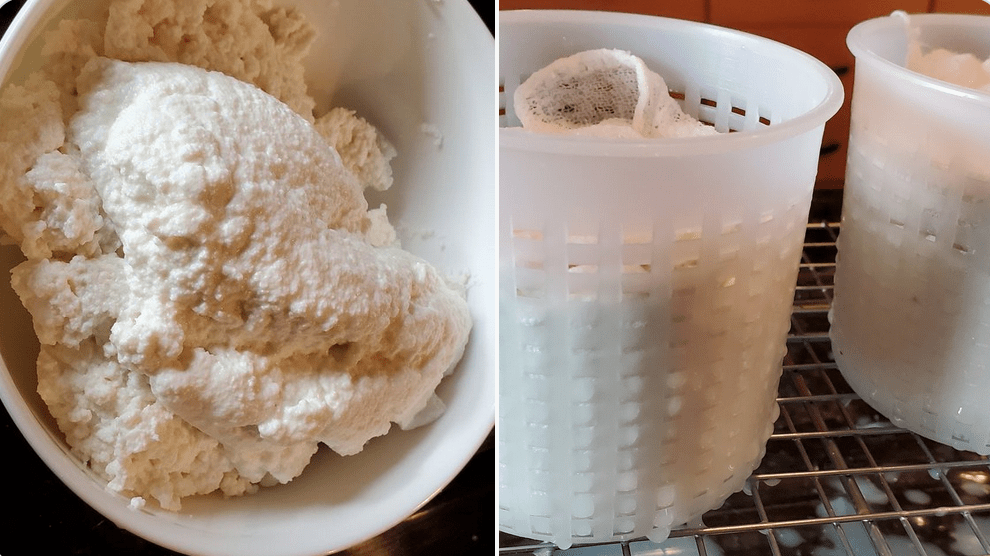
And I *also* got a full bowl of ricotta, enough to make 2 rounds of truffled ricotta salata. Incidentally, one of the best ways to taste the inherent differences between milks of different species is to make ricotta, because it basically has no other flavors besides “milk”. Cow ricotta is sweet but kinda bland. Goat has a noticeable lemon flavor. Sheep has a rich, buttery warmth to it that you should never hide in pasta fillings with heavy sauces. It’s lovely as a spread on bread (think Rondele, but less processed and gelatinous), as sliceable dry ricotta, and my favorite, mixed with some powdered sugar, lemon zest and tiny shavings of dark chocolate as a cannoli filling.

Here’s the winter pecorino at 2 months of age, at the beginning of March.

It was technically just about ready to eat, but the sheep cobble (pictured below) that I’d made the week before was so rich, creamy and soft-textured due to all the extra fat that I decided it wouldn’t hurt to let the Pecorino age longer and give the fats more time to break down.

But I wanted to point out something about the rind. Compare the two-month-old winter one above with the previous one I made in March of last year:

Both rinds were oiled during aging to help keep off unwanted molds. But the one I made in January is entirely covered in white geotrichum mold, while the spring one just has a dusting. I didn’t add any geo powder to the milk. That’s just what grew on the rinds, from spores in the milk and in the air.

The winter one has a lot more fat, which tends to retain more moisture in the curd. Here in the San Francisco Bay Area, winter is the dampest time of year. I often have to fight moisture-loving blue molds in the winter, and if you look closely on the winter pecorino you’ll see spots where the local blue started making pits in the rind before I ground lots of dry salt into it. So the winter one is a slightly moister cheese, aged in slightly damper conditions. More geotrichum is the result.

Even though I still have a bit of the super-rich sheep cobble, I opened up my wintertime pecorino yesterday evening.

Texture-wise, it’s pretty similar to the pecorino I made last spring. It doesn’t have the fatty mouthfeel the cobblestone has; it’s more of a proper semi-hard cheese (this is a good thing). There’s a definite flavor difference though. The spring one was nutty and a little sweet. This one has a bit more tang to it, with hints of hay.

I’m now planning to make another one in June with summer milk to get a 3-season comparison.

Originally tweeted by Lisa Caywood (@RealLisaC) on January 5, 2022.

Ep 3: Touring the Cheese Kingdom

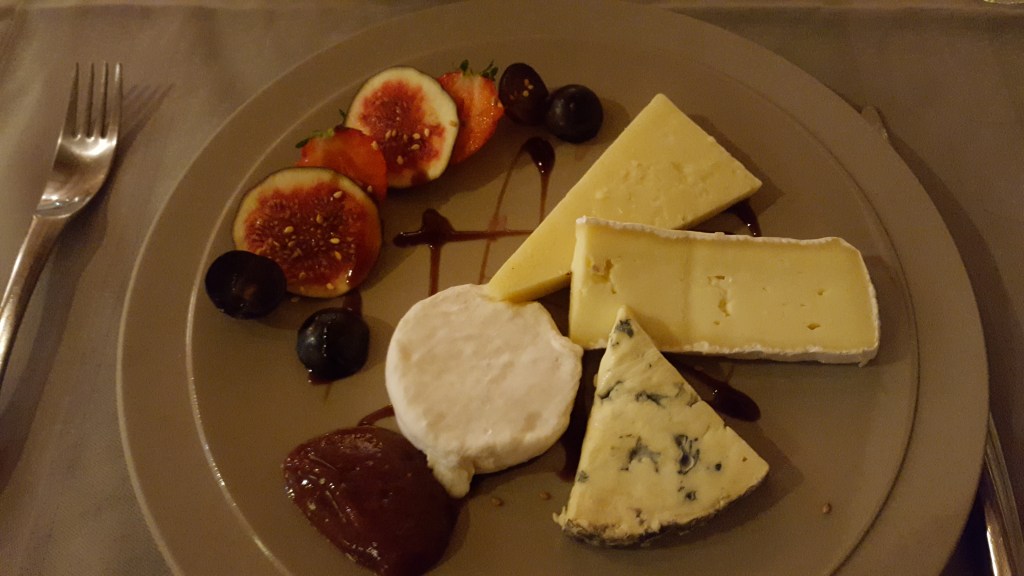
Cheese plate with lactic-set, bloomy rind, pressed and blue cheeses, accompanied by fresh fruits and quince syrup
Dessert in southwest France

In this episode, we get acquainted with the various phyla of the cheese kingdom–the lactic sets, the bloomies, the hard cheeses, the blues and more: what they are, a few examples of each type and suggestions of what to eat and drink with each. Be prepared for your next wine & cheese event!

Learn more about bloomy rind cheeses in Episode 7

Background music in this episode is drawn from Night on the Docks and OctoBlues via Wikimedia.

Why Some Cheeses Are Orange

Cheese isn’t naturally orange. These days the orange color comes from the seeds of annatto, a Central/South American plant. But the desire for yellow-hued cheeses goes back at least to the middle ages, and possibly even earlier…

The yellow and orange-colored cheeses are especially common in Northern Europe, where the majority of cheeses are made from cow milk. Cow milk has less fat than either sheep or goat milk, so it tends to have a more translucent quality to begin with.

In the later middle ages, especially in England & Holland with their rapidly growing urban middle classes, demand for butter–long a great luxury–was soaring. Which left dairyfolk w/a bit of a dilemma. They made a lot of money on butter, so there was real incentive to skim the cream off their milk before turning it into cheese. Certain breeds of cattle retain a fair amount of beta-carotene in their milk, but it mostly stays with the fat. Lower fat cheese, more of a dull-white hue. So for sales purposes, there was now also incentive to add colorant to the cheese. The video that spurred this post mentions marigold, in the days before South American plants were readily available in Europe.

But there’s another option: Lady’s Bedstraw

As that blog describes, Lady’s Bedstraw has long been used for dyes and also medicinal purposes. But it has yet another property: it’s a coagulant.

We don’t actually know when people started using animal rennet, but for most of history, plant rennets would have been more accessible for most people. I describe this a bit more in Ep 2. In the Mediterranean basin, fig sap, thistles and nettles were commonly used. But those aren’t things that grow as widely in northern Europe. OTOH Lady’s Bedstraw grows all over the place.

So it’s possible that Northerners were used to cheese being slightly yellow for centuries, long before the issue of fat levels came into question.

Originally tweeted by IntoTheCurdverse (@curdverse) on March 15, 2022.