When I first arrived in France in my youth and was presented with a wedge of brie after dinner, I did what most Americans do: I cut off the tip. And was promptly admonished. You’re supposed to cut along the side, getting a very thin wedge for yourself so that everyone else partaking of the cheese can do same, everyone getting an equal amount of rind & paste. At the time, it was explained to me as politesse.
I was reminded of that moment when this popped up in my Twitter feed the other day:
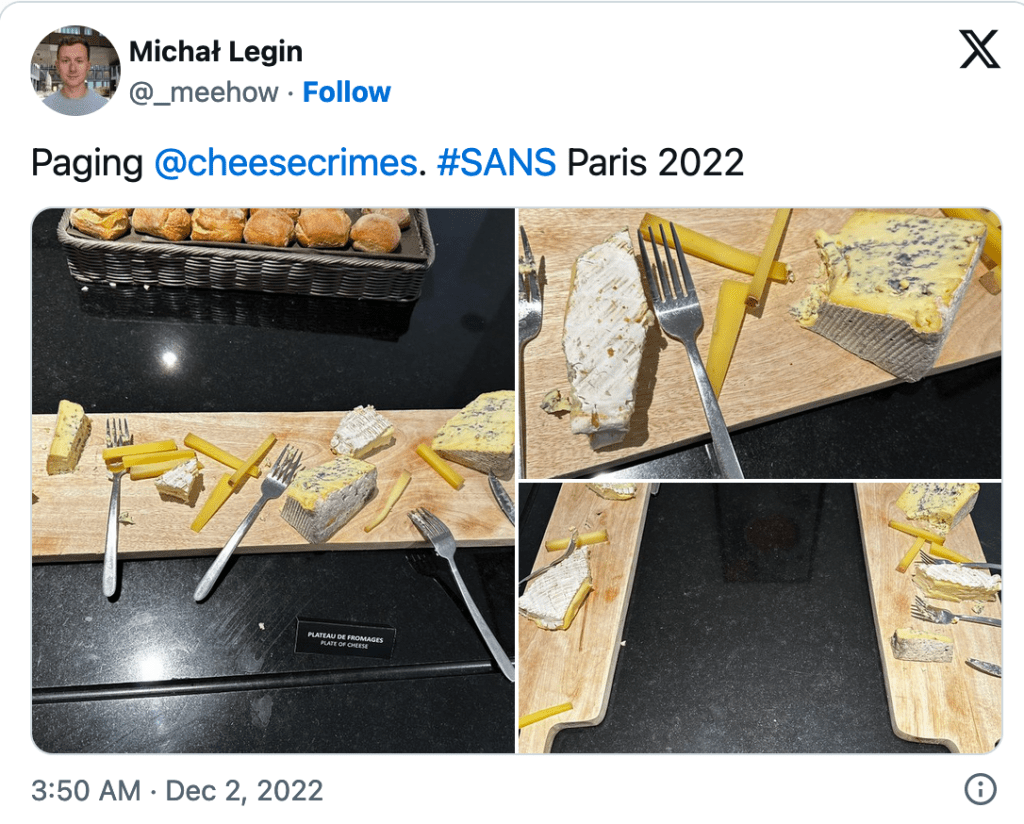
There it was, my long-ago crime, compounded many times over by many different people and splashed across the internet. (I did, in fact, confess to my own commission of this crime on Twitter a couple of years ago.)
Let’s dissect this particular crime scene for a moment: the board contains 3 types of cheese, a white bloomy rind, a semi-firm cheese (the one cut into sticks that look like French fries if you’re not looking closely), and a blue cheese. This is a common number and the usual assortment of cheese types.
Two of these cheeses, the bloomy and the blue, are mold-ripened cheeses. The bloomy ripens from the outside in (cf Ep 7); the blue, at least as far as the blueing is concerned, from the inside out (Ep 8). So if you cut off the tip, you’ll get either the most (for the blue) or the least (for the bloomy) ripe part of the cheese, while everyone after you gets progressively riper or less blue portions and more rind . And the rind itself contributes flavor & texture, so ideally you want to experience it in a consistent ratio to the interior. Thus the desire to have everyone cut themselves a small slice from the side, allowing equal portions of interior (the paste) and the rind for everyone.
In general, you won’t go wrong doing that with any kind of cheese. But then why is the other cheese pre-cut in matchsticks? This was a catered event, not a private gathering, and you don’t want everyone who comes along wrestling to cut from a large, hard wheel of cheese. It breaks the flow of the food line. So you might as well pre-cut a hard cheese that won’t stick to the board at room temperature (unlike a well-made bloomy), especially since food waste is calculated into the catering budget. The cut pieces will dry out slightly, having been cut in advance, but harder cheeses are basically pretty stable at room temperature for long periods of time. This particular cheese is in matchsticks because the source wheel is fairly large and tall. So the prep staff cut out thin wedges, and cut each wedge across (just a little bit of rind on each end for everyone), and discarded the very thin end and the thick outer edge in the back.
Once you understand the basic principle here — complete, balanced taste and texture for yourself with each piece of cheese, and the same for everyone else — any other seemingly arbitrary rules about cutting cheese should start to make sense.
That said, there’s an excellent video by the late Anne Saxelby that delves a bit further into the different cheese types, and does a great job of explaining the nuances and reasons for cutting a cheese one way vs another. It’s also a very soothing way to while away a bit of a lazy weekend afternoon or evening. If you’re short on time, though, skip down below the video for a few words about knives.
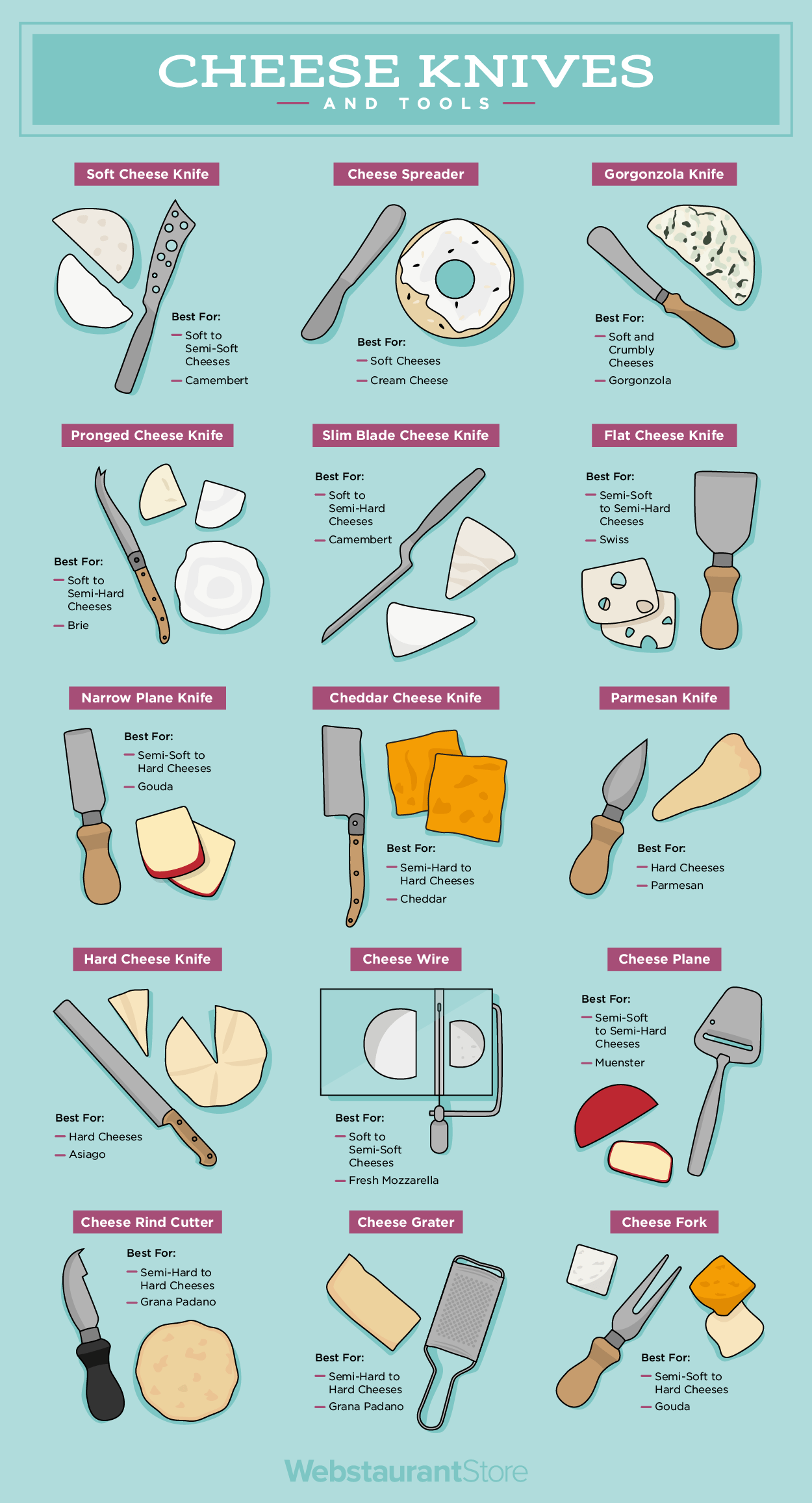
Just as it’s possible to lay out 8 different kinds of forks, 3 knives, and a multiplicity of spoons at a fancy meal, each with its own specified function, it is possible to put out multiple kinds of cheese knives. The reality is, if you’re putting out a board for your guests to serve themselves…well, unless everyone you know is a great cheese enthusiast, virtually no one will know one from the next and everyone will use whichever knife comes to hand to cut whichever cheeses they want.
My pragmatic recommendation is to keep a paring knife at the soft-cheese end of your board, and a larger, sturdier knife at the hard cheese end. It cuts down on the number of times you get brie (and the mold spores it contains) smeared across your pecorino. You might also choose to keep a blue on a separate board with its own knife, as blue molds are even more aggressive. Of the knives in the graphic below, the one that I’ve found that is genuinely better for its purported function than the general-purpose knives one normally has in the kitchen is the Soft Cheese Knife. Because there’s less surface area for the sticky paste to cling to, it slices in and out neatly and doesn’t tear up the little wedge you’re trying to cut in the process.
And be sure to listen to Episode 12 for suggestions on what to put on your holiday cheese board. Just make sure there’s room left on the board to cut the cheese! Happy holidays.


 Into The Curdverse