Leaves of edible plants are used to wrap foods in many different cultures. In warm regions, from Central America, to SE Asia and southern India, corn husks and banana leaves wrap tamales and other meat-starch fillings and sometimes serves as plates. Slightly further north, the Chinese fill lotus leaves with sticky rice and little bits of meat & quail eggs. Further north again, variations on stuffed cabbage are common across northern Eurasia.

Western Europe is kind of an anomaly when it comes to leaves: there aren’t many dishes that use them as wrappings…except for cheese!
Since we’re entering Spring and trees are leafing out again, it seemed a good time to look at the use of leaves in cheesemaking.
Small, soft cheeses are perhaps the cheeses most commonly aged in leaf wrappings, especially in the Mediterranean countries. Common leaf choices include chestnut, grape and fig, which are all readily available in those regions. Chestnuts are often associated with cold weather and Christmastime in English-speaking countries, and indeed they grow in a fairly wide range of climates, but they used to be everywhere in southern Europe–especially in the hills and other marginal land where goats and sheep also thrive. In early medieval Italy, some landlords even provided incentives to tenants to grow the trees, which provided a (nutritionally limited) flour alternative for those who couldn’t grow wheat, as well as bark that could be used in tanning hides. No surprise that their leaves would be a common choice for local herders.
Now, one of the reasons fig, grape and chestnut leaves are popular, besides their ubiquity in the Mediterranean, is their size: just big enough to wrap a hockey puck in one leaf. Hockey puck-sized cheeses are common in southern Europe, especially Provence, because the dry, often hilly terrain is best suited to raising goats and sheep, which give relatively small volumes of milk compared to cattle. So if you’re a small farmer without enormous herds–especially in the days before refrigeration, when you pretty much had to make cheese shortly after milking your animals each day–smaller cheeses make a lot of sense. Of course, you can also use smaller types of leaves, in which case you’ll just use several to enclose the entirety of the cheese.
One can use leaves from any type of non-toxic plant. Lemon and orange leaves are lovely. Maple is a current favorite of several New England cheesemakers. (Temperate North America was once rich in chestnut trees as well, until a blight in the early 1900s nearly wiped them out. Gastropod has a great episode on the American chestnut.) Down in the southwestern US, hoja santa (aka Mexican pepper) leaf is becoming a trendy choice. I’ve also used cherry and blackberry leaves.
Smaller cheeses will dry out faster than larger ones, which is why many are eaten young, around 2-3 weeks old. With a small cheese, you obviously don’t want to wind up with more rind than paste, so aging it means balancing just enough time to develop flavor while avoiding dryness or mold development. That’s where the leaves come in: they help keep the cheese in its own moist little bubble as it ages, so no rind forms. And since the leaves are usually soaked in alcohol, molds don’t have hospitable surfaces to grow on.
Larger, longer-aged cheeses often have natural rinds, but there are also larger cheeses that are wrapped in several larger leaves, like the award-winning Rogue River Blue (grape leaves), its Spanish counterpart Valdeon (maple or chestnut), and Cornish Yarg, coated in nettles (more on nettles in a minute).
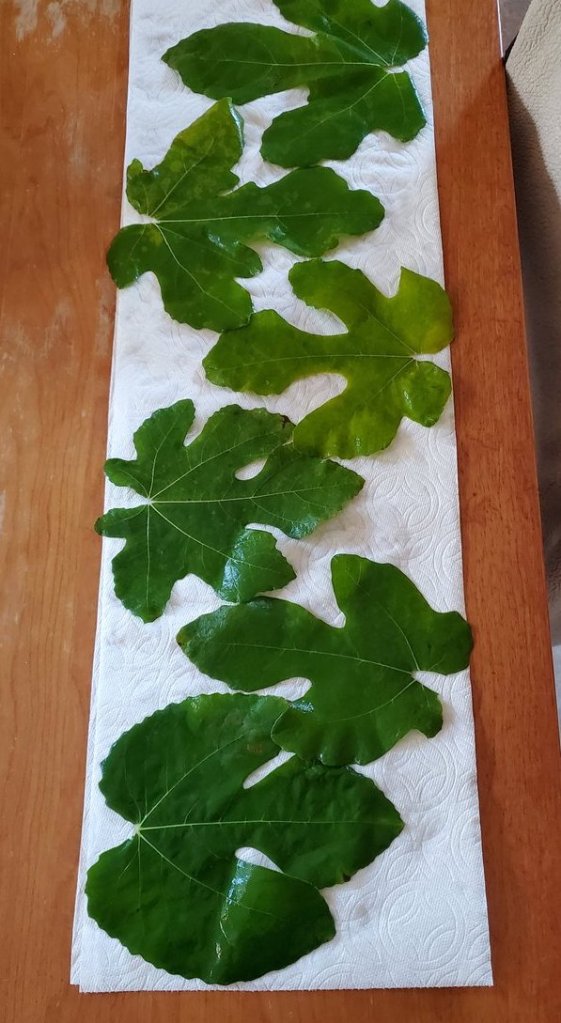
The way you use the leaves is to steam or blanche them a bit, then plunge them into ice water. This softens the more rigid fibers in the leaf, making it easier to fold, and also kills yeasts and other unwanted things that would affect the cheese in unwanted ways.
Then you let them air dry and macerate them in some kind of eau de vie to preserve them, so they don’t start rotting while you’re aging your cheese. Brandy is a common choice, but any high-proof liquor will work.
Fresh goat milk has a slightly lemony flavor, so I’m rather fond of using lemon leaves for wrappers. I soak a few lemons in a pint of vodka for a week or two, and then soak the lemon leaves in the lemon vodka.
Young, moist cheeses such as banons absorb the flavors of the leaves rather well, though some leaf types (ahem, blackberry) impart a much stronger flavor than others (whispers, cherry). If the cheese is left to age for a while, the character of the fruit flavor will also undergo aging: a young goat cheese wrapped in fig leaves will have a faintly sweet, floral flavor, but nothing that screams “Figs!”. But give it a couple of months, and it begins tasting specifically of dried figs.
Some leaves have another use in cheesemaking: as a source of plant rennet. Some plant rennets come from flowers, such as thistle rennet (discussed a lot in Ep 6). Fig sap has been used as a coagulant in the Mediterranean since ancient times. Lady’s bedstraw, a plant with bright yellow flowers, can be used as rennet by crushing the stalks, flowers and/or leaves. It also turns things yellow, so was used to enhance the color of both butter and cheese in medieval northwestern Europe (now annatto, a dye made from the seeds of a Mesoamerican plant, is used instead). There’s nettle leaf rennet. And in West Africa, a few different types of leaves are used for rennet as well.
 Into The Curdverse